





Мовою «Українська» поки що недоступно — ви читаєте англійське видання.
Combat drone from India: DRDO flies Swift demonstrator for the seventh time, Ghatak UCAV to follow
An autonomously landed flying wing in Karnataka marks “intermediate maturity” for India's combat drone. The small Swift is to evolve into the 13-tonne Ghatak, but the project is classified and the timetable uncertain.
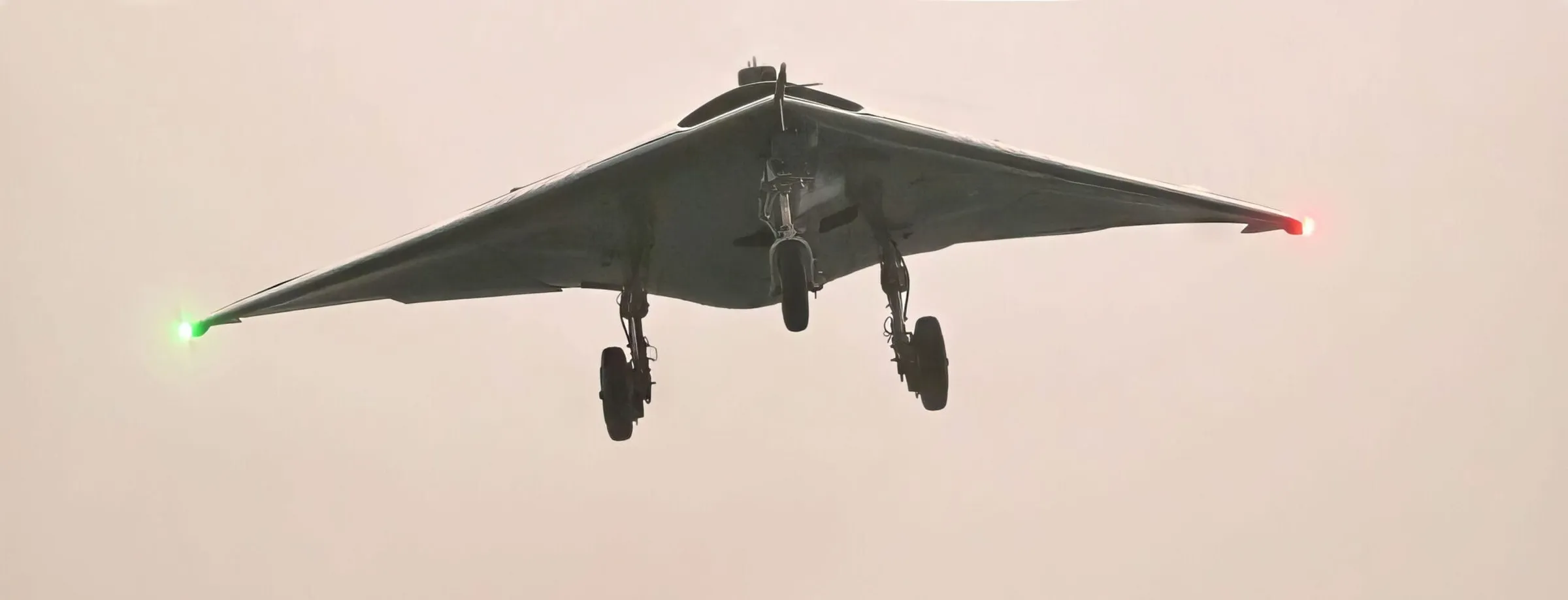
India is making clear progress with its own stealth combat drone. The seventh test flight of a demonstrator was successful, which means the two-stage Swift programme has reached “intermediate maturity”. The next step is further development into a large, weapon-capable system with a take-off weight of 13 tonnes.

The flight test on 15 December took place at the Aeronautical Test Range Chitradurga in Karnataka. There, the state-owned Defence Research and Development Organisation (DRDO) flew the sub-scale Autonomous Flying Wing Technology Demonstrator Swift (Stealth Wing Flying Testbed), a high-speed unmanned aerial vehicle (UAV) of flying-wing design. The successful demonstration is regarded as proof of the technological maturity of the autonomous stealth drone. According to local media, India has thus joined the elite club of countries that have mastered the control of tailless flying-wing technology.
The first step towards the combat drone: Swift
The UAV was designed and developed by DRDO's Aeronautical Development Establishment (ADE). It first took off, before a small circle, as early as July 2022. Six flight tests followed with two prototypes and with demonstrators in various development configurations. These tests formed the basis for progress on a robust aerodynamic and control system, on integrated real-time and hardware-in-the-loop simulation and on a modern ground control station.

For the now successful seventh flight in the final configuration, the team had optimised avionics systems, integration and flight operations. The high-speed UAV landed autonomously, without any input from ground radars, infrastructure or a pilot. According to official statements, this represents “a unique capability demonstration enabling take-off and landing from any runway with surveyed coordinates”. This was achieved by fusing onboard sensor data with indigenous satellite-based augmentation. GAGAN receivers (GPS Aided GEO Augmented Navigation) improve the accuracy and integrity of GPS navigation.
The prototype weighs around one tonne. It is made of a lightweight, domestically developed carbon prepreg composite with fibre interrogators embedded in its structure for health monitoring. This is described as an example of the self-reliance of the country's aerospace technology. Propulsion comes from the Russian NPO Saturn MT36 cruise missile engine. Congratulations on the successful flight tests and the preliminary stage reached came from Samir V. Kamat, Secretary of the Department of Defence Research and Development (and Chairman of DRDO). They were addressed to DRDO and to the research and development teams of the Indian Institute of Technology (IIT) Bombay and IIT Kanpur.
Next comes Ghatak
It is called a preliminary stage because the capabilities of the Swift demonstrator are to be expanded further. The goal is a weapon-capable platform, an unmanned combat aerial vehicle (UCAV) for the Air Force and even a ship-based version for the Navy. Under the name Ghatak, this Autonomous Unmanned Research Aircraft (AURA) will then be considerably larger, with a take-off weight of 13 tonnes. Planned are flight altitudes of up to 9,000 metres and the use of precision weapons over a radius of more than 1,000 kilometres, at supercruise speeds of up to Mach 1.2.

Because Ghatak is treated as a classified project in India, little information is available. The developers will, however, certainly have in mind the Chinese UCAV project Shenyang/Hongdu GJ-11 “Sharp Sword” (see also video below), which has been further advanced since 2013. A full-size Ghatak model is already being tested at a facility in southern India. With a view to reducing the radar cross-section (RCS), technologies that deflect and detect radar waves are being developed there, as are radar-absorbent paints.
The following capabilities are planned for the production model: network-centric data links, command and control, internal weapons carriage and AI-assisted weapons release, fully autonomous unmanned flights over longer distances, satellite links, navigation systems and electro-optical targeting. Electronic warfare (EW) suites will probably be added.
A further mechanism is thrust vectoring behind the 48 kN GTX-35VS Kaveri engine. This engine long delayed the LCA Tejas fighter and has apparently “returned”. According to the latest information, the thrust vectoring control is being developed in time for a Ghatak flight test programme intended for 2025/2026.

The usual caveat applies here as well: timelines for Indian programmes and processes should always be taken with a grain of salt. With regard to the sequence of India's various Defence Procurement Procedures, British colleagues speak of “Byzantine development processes”.
Автори фото
© DRDO · © CCTV 4Читайте також

Морські дрони з України уразили корвет «Merkuri» у Бенгазі та вантажне судно «Ascalon» біля Лівії

Удари дронів по Росії вражають нафтову і ракетну промисловість під час осіннього наступу «Мадяра»

БпЛА літакового типу та супутники: TRL Defense про мережеву розвідку

Дроновий центр Алабуга приймає працівників, направлених Ганою та ДР Конго, для ударних дронів Росії
