





Мовою «Українська» поки що недоступно — ви читаєте англійське видання.
Drone carrier TCG Anadolu: Turkish task group berths in Rotterdam during Steadfast Dart
At the end of February, the Turkish drone carrier TCG Anadolu lay in Rotterdam with its four-ship group. On board, the Turkish defence industry showed its systems to a select delegation; in the Baltic, a NATO first with the Bayraktar TB3 followed.
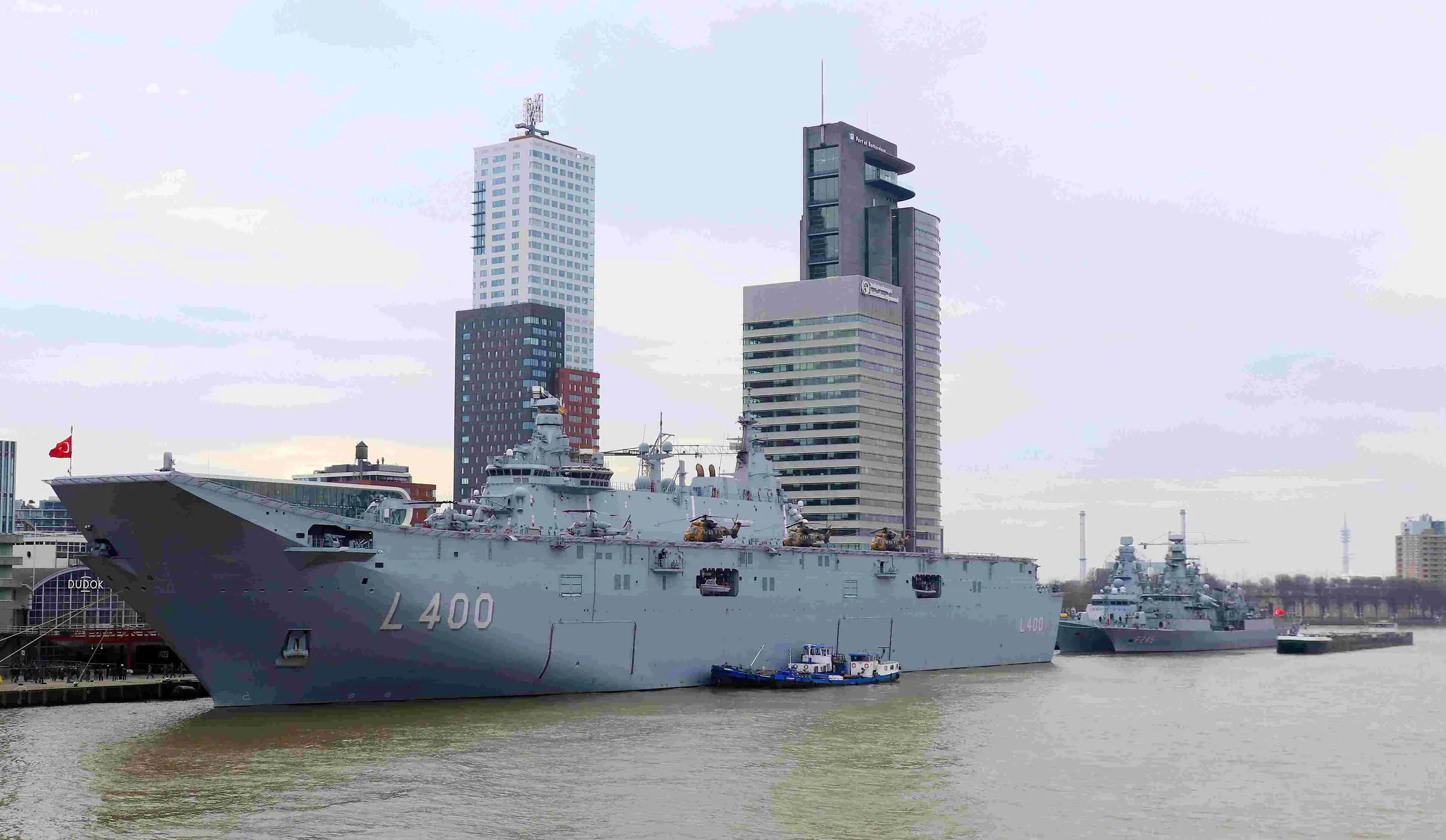
The Turkish drone carrier TCG Anadolu, flagship of the Turkish Navy, appeared on the horizon of the Maas at the end of February and for a short time turned Rotterdam into the stage for one of NATO's most strategically symbolic naval movements this year. It was accompanied by the frigates TCG İstanbul and TCG Oruçreis and the replenishment ship TCG Derya.
The four-ship group was hard to miss. It was sailing as part of NATO's ongoing exercise series Steadfast Dart. Moored near the Holland Amerikakade and in the Waalhaven, the ships attracted a great deal of attention: from the media, from maritime observers and from the large Turkish community in the Netherlands, which spontaneously turned the port area into a kind of celebration.


Expeditionary force for several domains
The composition of the visiting group shows how ambitiously Turkey is increasingly shaping its maritime posture. At its core is TCG Anadolu (L 400): the landing ship (Landing Helicopter Dock) is 232 metres long and is the first NATO platform able to launch and recover unmanned combat aerial vehicles (UCAV) from a flat flight deck.
Sailing in support of the flagship were:
- TCG Derya: second-largest ship of the Turkish Navy, responsible for logistics and command and control (C2) support
- TCG İstanbul (F 515): first ship of the new I-class frigates
- TCG Oruçreis (F 245): modernised Barbaros-class frigate
Because the task group operates independently, Turkey gains operational flexibility. The spectrum ranges from amphibious operations and strike missions with drones to integrated maritime security.
Steadfast Dart 2026 as the strategic framework
The reason for the stay in Rotterdam was Steadfast Dart 2026. It is NATO's largest exercise this year and at the same time the first comprehensive operational test of the Allied Reaction Force (ARF), the alliance's new rapid reaction force.
The exercise began on 2 January and will end on 18 March. It involves:
- 10,000 troops
- 17 naval vessels
- more than 1,500 military vehicles
- a combined land and sea training area in Germany and the Baltic Sea
Ankara currently provides both the Commander Amphibious Task Force (CATF) and the Commander Landing Force (CLF), giving it a central role. Turkey is thus making a major contribution to validating NATO's ability to reinforce Europe rapidly in a crisis.
Emden and Rotterdam: logistics as a show of strength
On its way to the Netherlands, the task group had previously made an important stop in Emden, Germany. Footage from there shows 149 military vehicles being unloaded from TCG Anadolu.
To reinforce the land component of the exercise, around 650 soldiers and a further 149 vehicles of Turkey's 66th Mechanised Infantry Brigade also came to Germany.
A civilian chartered ro-ro ship (roll-on/roll-off) is planned for returning equipment and vehicles after the exercise, as is customary in NATO logistics.
Festive mood on the quay, access by invitation only
Although the visit was operational in nature, Rotterdam's quays became a kind of festival stage. Members of the Dutch-Turkish community turned out in large numbers: they waved flags, played music, filmed the ships and celebrated their arrival with visible pride and a great deal of emotion.
Some even tried to gain access, for example by talking to security staff or through contacts with invited guests. For the public, however, access remained strictly prohibited.
Behind secured checkpoints, by contrast, a small, carefully selected delegation visited an exclusive Defence Industry Exhibition on board TCG Anadolu. It included representatives of the Royal Netherlands Navy, the Dutch Ministry of Defence and the Dutch defence industry.
What was on offer there was far more than a static display: a curated presentation of Turkey's rapidly growing industrial and maritime capabilities.
Drone carrier as a showcase for the Turkish defence industry
In detailed briefings, the invited guests were introduced to a range of Turkish defence systems. Each of them represents an important pillar of the country's growing military production base.
Baykar TB3 UCAV
The unmanned combat aircraft is ship-based and optimised for deck operations on the Anadolu. It has folding wings and extended endurance and can employ precision-guided munitions such as the MAM-L. With the TB3 from manufacturer Baykar, Turkey is entering naval unmanned combat aviation.


Pirana KUSV (Kamikaze-Unmanned Surface Vehicle)
The fast, expendable surface drone is intended for precision strikes on targets at sea or close to the coast. It is designed for autonomous operation and plays a role in swarm tactics for sea denial.
Vuran Tactical Armored 4×4 Vehicle

The modular armoured multi-purpose vehicle is used for troop transport, reconnaissance and security as well as for supporting amphibious task groups.

MKE TOLGA SHORAD system
This short-range air defence system is based on a hard-kill architecture. It combines kinetic effectors of several calibres to engage unmanned aerial vehicles (UAV), loitering munitions, helicopters and low-flying aircraft.

MKE BALKAN 130 millimetre Chaff-S munition
The modern decoy munition for maritime use creates chaff clouds against radar, making target acquisition more difficult for radar-guided missiles.
BMC Kirpi II (4×4) MRAP
The modern mine-protected vehicle features a reinforced V-shaped hull, improved ballistic protection and modular mission variants.


MKE Malam bottom mine
This naval mine is laid on the seabed. It is suitable for depths of up to 100 metres and is intended to block strategic sea lanes.
FNSS Amphibious Assault Vehicle MAV (ZAHA)
The amphibious armoured vehicle carries naval infantry from ship to shore. It offers ballistic protection and is propelled by waterjets.
A look at the aircraft on board
In addition to the industry exhibits, the guests were also shown parts of the Anadolu's aircraft contingent.
The focus was on the AH-1W Super Cobra operated by the 353rd Naval Attack Helicopter Squadron. The Turkish AH-1Ws have been upgraded: they have five missile warning sensors and are compatible with both CİRİT 70 millimetre laser-guided rockets and UMTAS/L-UMTAS anti-tank missiles.

Also in the hangar was an SH-60B Seahawk of the 351st Naval Helicopter Squadron, representing the ship's anti-submarine warfare capabilities. Three further AH-1W Cobras and three AS352UL Cougars completed the contingent.
With this equipment, the Anadolu covers a broad spectrum of missions: close air support, reconnaissance, maritime surveillance, transport and rapid deployment of troops.


A NATO first: armed UCAV mission from a flat deck
During the Baltic phase of Steadfast Dart, Turkey reached an important milestone. A Bayraktar TB3 took off from the drone carrier TCG Anadolu, carried out a precise MAM-L strike and then returned safely.
For the first time in NATO's history, an armed UCAV mission was thus conducted entirely from a flat-deck ship.
Operations in the north and the south
After Rotterdam, the task group continued its operations in the northern area of operations. It took part in Neptune Strike 26.1, an enhanced vigilance activity in the GIUK gap, in Arctic waters and in the Baltic Sea.
It then headed to the Mediterranean for Dynamic Manta 26, a NATO anti-submarine warfare exercise, and Dynamic Mariner 26, a maritime certification exercise of the ARF. A stopover in Rota (Spain) has also been confirmed.
The entire deployment of the Turkish naval group runs from 20 January to the end of April 2026. It takes the ships through the Mediterranean, the Atlantic, the North Sea, the Baltic Sea and the Adriatic.
Rotterdam as a hub for NATO reinforcement
That Rotterdam was able to host such a high-ranking naval formation despite having to manage civilian visitor flows, security measures and parallel NATO activities demonstrated the port's role as the alliance's maritime reinforcement centre.
Visibility as a means of deterrence
Steel hulls on the Maas. Drone wings, folded, and helicopters on and below deck.
Amphibious vehicles in the well deck.
Rotterdam experienced more than a port visit: it saw a staged demonstration of military capability. Whether in the Baltic or the Mediterranean, in UCAV missions or in the presentation of the defence industry, the task group around the Anadolu appeared both as a combat formation and as a strategic ambassador.
On display were reach, readiness and industrial strength. Where rapid reinforcement, contested sea lanes and drone-saturated battlefields shape the security situation, visibility itself becomes a form of deterrence.
The stage was Rotterdam, but the message reached far beyond it.
Автори фото
© DAPPAWillem Sander Termorshuizen Tieme Festner · © DAPPA/Willem Sander Termorshuizen & Tieme FestnerЧитайте також

Морські дрони з України уразили корвет «Merkuri» у Бенгазі та вантажне судно «Ascalon» біля Лівії

Удари дронів по Росії вражають нафтову і ракетну промисловість під час осіннього наступу «Мадяра»

БпЛА літакового типу та супутники: TRL Defense про мережеву розвідку

Дроновий центр Алабуга приймає працівників, направлених Ганою та ДР Конго, для ударних дронів Росії
