





Мовою «Українська» поки що недоступно — ви читаєте англійське видання.
THeMIS UGV: Hanwha and Milrem Robotics take the platform to South Korea, Australia and New Zealand
Hanwha has already acquired two THeMIS platforms. Together with Milrem Robotics, the group plans to research the UGV, market it in the region and possibly build it locally, with an option on the MIFIK autonomy kit.
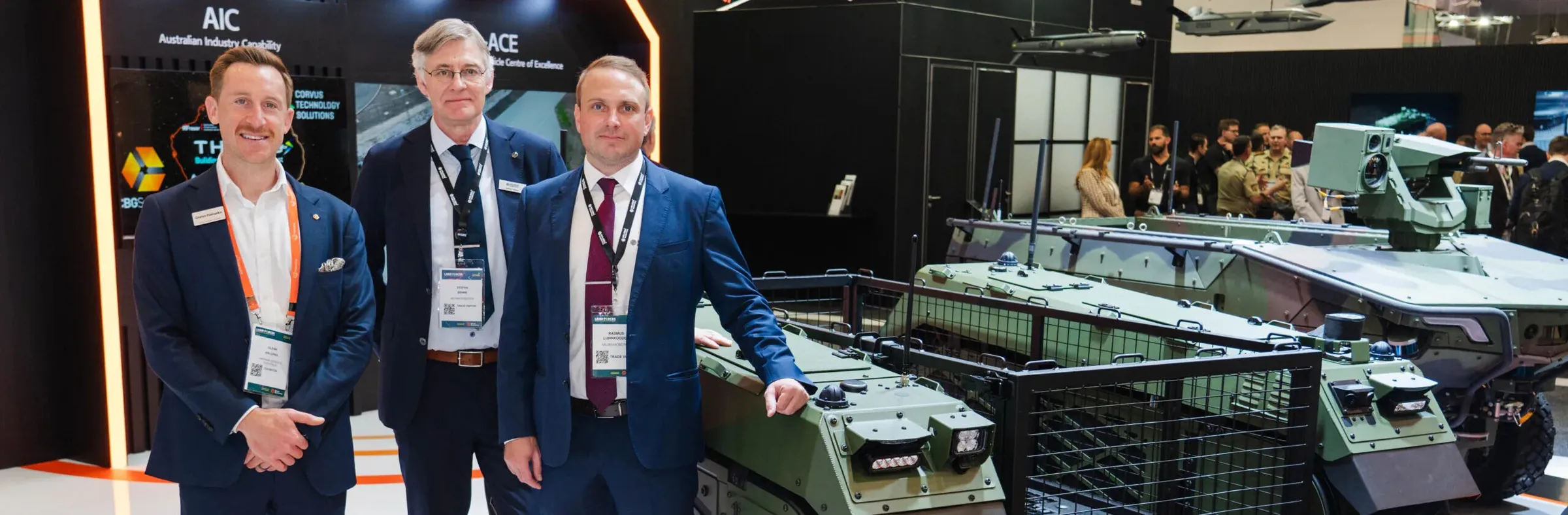
Milrem Robotics and Hanwha are expanding their cooperation on unmanned ground systems. At its core is the THeMIS unmanned ground vehicle (UGV): in South Korea, Australia and New Zealand, the THeMIS UGV is to be used for research and marketing, and local production is also possible.
Hanwha has acquired two THeMIS platforms for this purpose. One is intended for projects in South Korea, the other for initiatives in Australia.
Several research and development projects involving Hanwha are to use a THeMIS UGV in South Korea. There, the platform is meant to help develop and test advanced unmanned and autonomous capabilities on the ground.
THeMIS is a tracked UGV with a broad range of applications. Depending on the mission, different payloads can be mounted, for example for logistics, reconnaissance or fire support, but also for other purposes.
Australia and New Zealand: marketing and building the UGV locally
For Australia and New Zealand, the cooperation provides for Hanwha to market, produce, sell and support THeMIS locally.
This includes:
- Building a supply chain in Australia.
- Local maintenance and upgrade capabilities.
- Integration of payloads and subsystems.
- Adaptation to the requirements of regional customers.
Milrem Robotics contributes localisation planning and technology transfer, as well as technical know-how and engineering expertise.

Kuldar Väärsi, CEO of Milrem Robotics, said: “Together with Hanwha, we are creating a strong foundation for expanding unmanned and autonomous capabilities in the Asia-Pacific region.”
The cooperation also includes an option: Milrem’s Intelligent Function Integration Kit (MIFIK) could be integrated into Hanwha’s crewed and unmanned platforms.
Among other things, the kit is intended to enable vehicles to navigate autonomously and carry out missions. Existing platforms thus gain additional capabilities without having to be fundamentally rebuilt.
The new initiatives build on the existing cooperation between Hanwha and Milrem Robotics. The two companies already work together on ground robotics in South Korea, and they are jointly pursuing Romania’s UGV programme, including possible local production and industrial participation.
In parallel, Hanwha Aerospace is expanding its UGV competence with its own Arion-SMET. The system was selected as the winner of the South Korean multi-purpose UGV programme in July 2026.
Автори фото
© Milrem RoboticsЧитайте також

Морські дрони з України уразили корвет «Merkuri» у Бенгазі та вантажне судно «Ascalon» біля Лівії

Удари дронів по Росії вражають нафтову і ракетну промисловість під час осіннього наступу «Мадяра»

БпЛА літакового типу та супутники: TRL Defense про мережеву розвідку

Дроновий центр Алабуга приймає працівників, направлених Ганою та ДР Конго, для ударних дронів Росії
