





Мовою «Українська» поки що недоступно — ви читаєте англійське видання.
Unmanned helicopter U145: Airbus Helicopters shows a first model at ILA Berlin
An unmanned helicopter based on the H145: Airbus plans a first flight of the U145 with a safety pilot at the end of 2026, with entry into service following at the start of the next decade. For air-launched effects, the manufacturer is cooperating with MBDA.
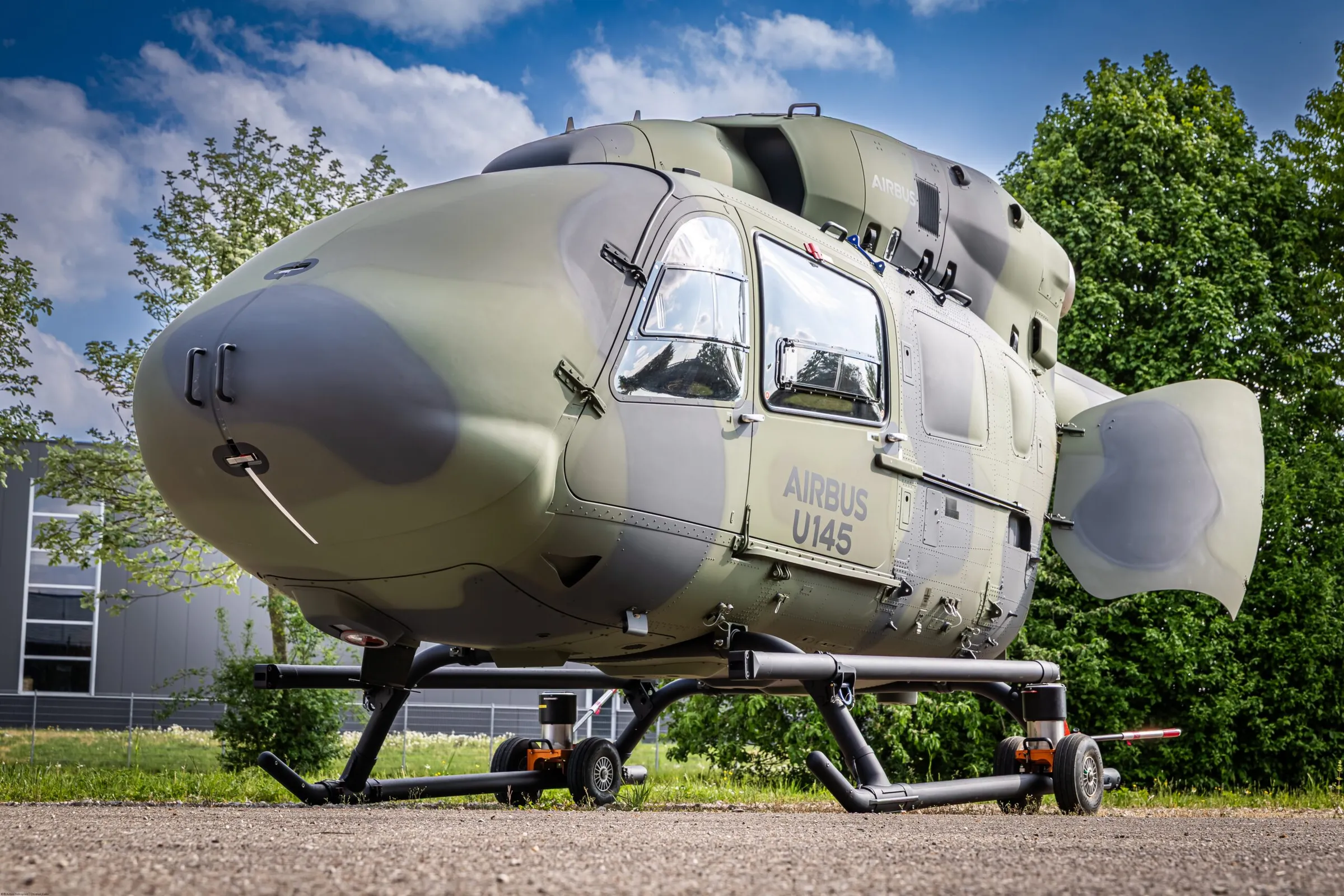
Airbus Helicopters is presenting the new U145 for the first time at ILA Berlin. A true-to-scale model is on display at the aerospace show; as an unmanned helicopter, the system is derived from the proven H145 multi-purpose helicopter. The first flight is scheduled for the end of 2026, still with a safety pilot on board. The U145 is due to enter service at the start of the next decade.
Matthieu Louvot, CEO of Airbus Helicopters, describes the offer: “With the U145, we are offering our customers an autonomous, unmanned version of the H145, combining the proven platform, performance and payload capacity of the helicopter with the capabilities of modern unmanned aircraft systems.” Together with leading specialists in autonomous missions, Airbus intends to develop the system further and in this way strengthen the European ecosystem for unmanned systems.
Unmanned helicopter without a cockpit
For Airbus, this is already the second rotorcraft programme in which a crewed type becomes an unmanned system. The first was the VSR700, which is based on the Cabri G2 light helicopter. To enable fully autonomous operation, the U145 receives specially developed sensors and autonomy functions supported by artificial intelligence (AI).
Unlike the crewed H145, the platform no longer has a cockpit. Instead, the airframe has been optimised for transport tasks: these include an integrated nose hatch with a fold-out loading platform and a specially designed cargo floor.
Airbus is developing the U145 as a mission-agnostic platform for both civil and military applications; the maximum take-off weight is 3,800 kilograms. For now, the focus is mainly on transporting larger loads and supplies. In the manufacturer’s view, however, the modular design opens up numerous other uses, for example in disaster relief, wildfire fighting, reconnaissance and surveillance missions, or as a carrier platform for air-launched effects.
The partner in this area is the European missile manufacturer MBDA. Concepts in which crewed and unmanned aircraft operate together (manned-unmanned teaming) are also planned.
In parallel, Airbus US Space & Defense is offering the MQ-72C to the US Marine Corps, together with partners Shield AI, L3 Harris and Parry Labs. This fully autonomous development of the UH-72B Lakota multi-purpose helicopter has been tailored specifically to the requirements of the US armed forces.
The H145 family as the basis
The H145 family is today one of the most successful helicopter platforms in its class. More than 1,800 aircraft are in service worldwide with armed forces, authorities and civil operators; together they have already logged more than 8.5 million flight hours. The H145 is powered by two Safran Arriel 2E engines with full authority digital engine control (FADEC) and is considered particularly quiet and low in emissions. According to Airbus, it has the lowest noise signature and the lowest CO₂ emissions in its class.
Автори фото
© Airbus 2026Читайте також

Морські дрони з України уразили корвет «Merkuri» у Бенгазі та вантажне судно «Ascalon» біля Лівії

Удари дронів по Росії вражають нафтову і ракетну промисловість під час осіннього наступу «Мадяра»

БпЛА літакового типу та супутники: TRL Defense про мережеву розвідку

Дроновий центр Алабуга приймає працівників, направлених Ганою та ДР Конго, для ударних дронів Росії
