





Military helicopters in focus: Salzburg hosts the Helicopter Tactics Symposium for 19 nations
For military helicopters, unmanned aircraft, electronic warfare and dense reconnaissance are putting established operating principles to the test. At the 17th Helicopter Tactics Symposium of the MHTC, experts are discussing this in Salzburg, hosted by the Austrian Armed Forces (Bundesheer).
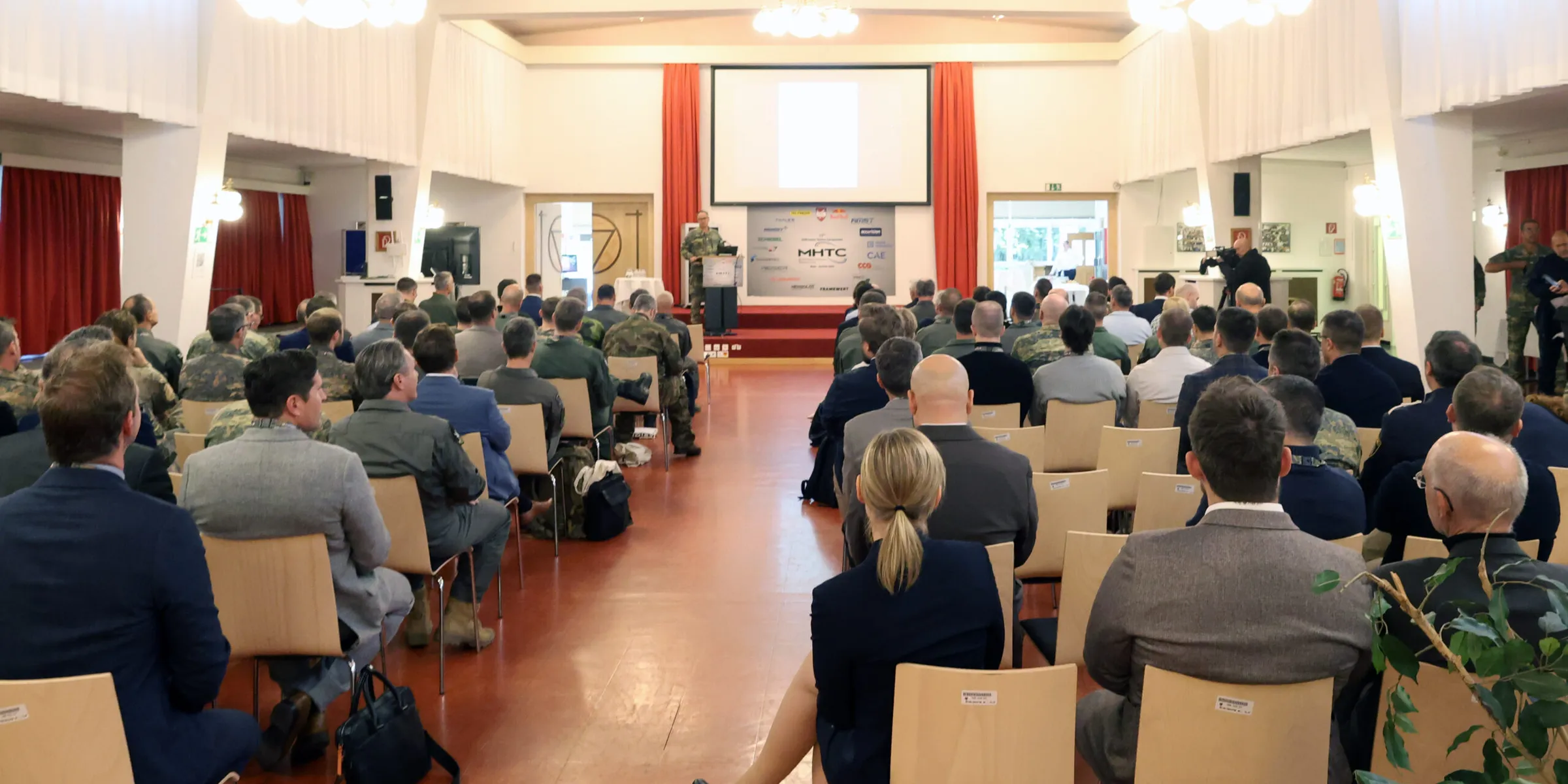
From 3 to 5 November 2026, around 120 military helicopter experts from 19 European nations are meeting at the Schwarzenberg barracks near Salzburg. Their subject is the challenges facing modern military air operations. The host is the Multinational Helicopter Training Centre (MHTC), which is holding its 17th Helicopter Tactics Symposium. The agenda covers the lessons from Russia's war of aggression against Ukraine, the growing use of unmanned aircraft and electronic warfare. A further question is how military helicopters can be protected and employed under increasingly difficult operational conditions.
The Austrian Armed Forces (Bundesheer) also see the event as an important element of their international cooperation in military training.

16 nations in the training network
The MHTC is based at Sintra Air Base in Portugal. The international centre pools training and expertise for military helicopter operations. It grew out of an initiative of the European Defence Agency (EDA), and in 2024 it took over responsibility for the EDA's multinational helicopter training programmes.
Since Switzerland joined in March 2026, the centre has had a total of 16 member nations, Austria among them. Austrian military helicopter pilots have also repeatedly served as instructors in recent years. The MHTC aims to strengthen cooperation between European armed forces, further develop common tactical procedures and improve the operational readiness of military helicopter crews.

The symposium is organised by the MHTC. It is part of a European training and cooperation initiative that has been established for many years, and it goes well beyond an international exchange of experience. Changes on modern battlefields are increasingly calling the established operating principles of military helicopters into question. Above all, the issue is how manned aircraft can be employed in an environment shaped by almost permanent reconnaissance, long-range weapon systems, unmanned aerial vehicles and targeted jamming of electronic systems.
Opening with Governor Edtstadler
Karoline Edtstadler, Governor of the State of Salzburg, attended the opening of the three-day specialist event. The symposium was officially opened by Colonel Jorge Inácio, Commander of the MHTC, and Brigadier Gerhard Köstner of the Air Force Command (Kommando Luftstreitkräfte). Köstner is responsible for organising this year's event, and it is thanks to his commitment that Austria is the host this year.
For the brigadier, this brings an advantage: “It gives us the opportunity not just to send a few participants, but to let far more Austrians take part.” Being the host also gives more freedom in shaping the programme: “We have also invited the Ministry of the Interior and numerous companies. And you can only do that if you act as the organiser yourself.”
The programme also includes a small exhibition area, housed in the officers' mess of the Schwarzenberg barracks in Salzburg. Köstner explains why: “We have to become faster and more agile. And a format like this lends itself to an exchange between the users and industry.”
Military helicopters: how the war in Ukraine is changing helicopter tactics
One focus of this year's symposium is the experience from Ukraine and the Baltic region. The Russian attack on Ukraine has been ongoing since February 2022. It has revealed fundamental changes in warfare: unmanned aircraft used in large numbers, reconnaissance and fires that are networked with each other, and electronic warfare employed intensively.
The consequences for military helicopters are considerable. Their traditional tasks include transporting troops and materiel, casualty evacuation, search and rescue missions, fire support and conducting airmobile operations. In many of these, helicopters have to fly comparatively close to potential danger areas or remain there for a certain time. In airspace that is increasingly monitored and contested, precisely these operating conditions have become particularly demanding.
The key finding is not that military helicopters are fundamentally losing importance. Rather, whether their employment succeeds increasingly depends on how well reconnaissance, self-protection, mission planning, communication and cooperation with other forces work.
Photo credits
© Bundesheer/Riedlsperger
Continue exploring

Sea drones from Ukraine hit corvette “Merkuri” in Benghazi and freighter “Ascalon” off Libya

Drone strikes on Russia hit oil and missile industry in Magyar's autumn offensive

Fixed-wing drones and satellites: TRL Defense on networked reconnaissance

Alabuga drone hub takes in workers placed by Ghana and DR Congo for Russia's attack drones
