





Autonomous drones from Occam: from the front line into development
Occam develops software intended to let drones from different manufacturers act as autonomous drones. At the Future Forces Forum 2026, co-founder and CEO Gui Wainwright explains how work with Ukrainian brigades shapes development and who should regulate autonomous systems.
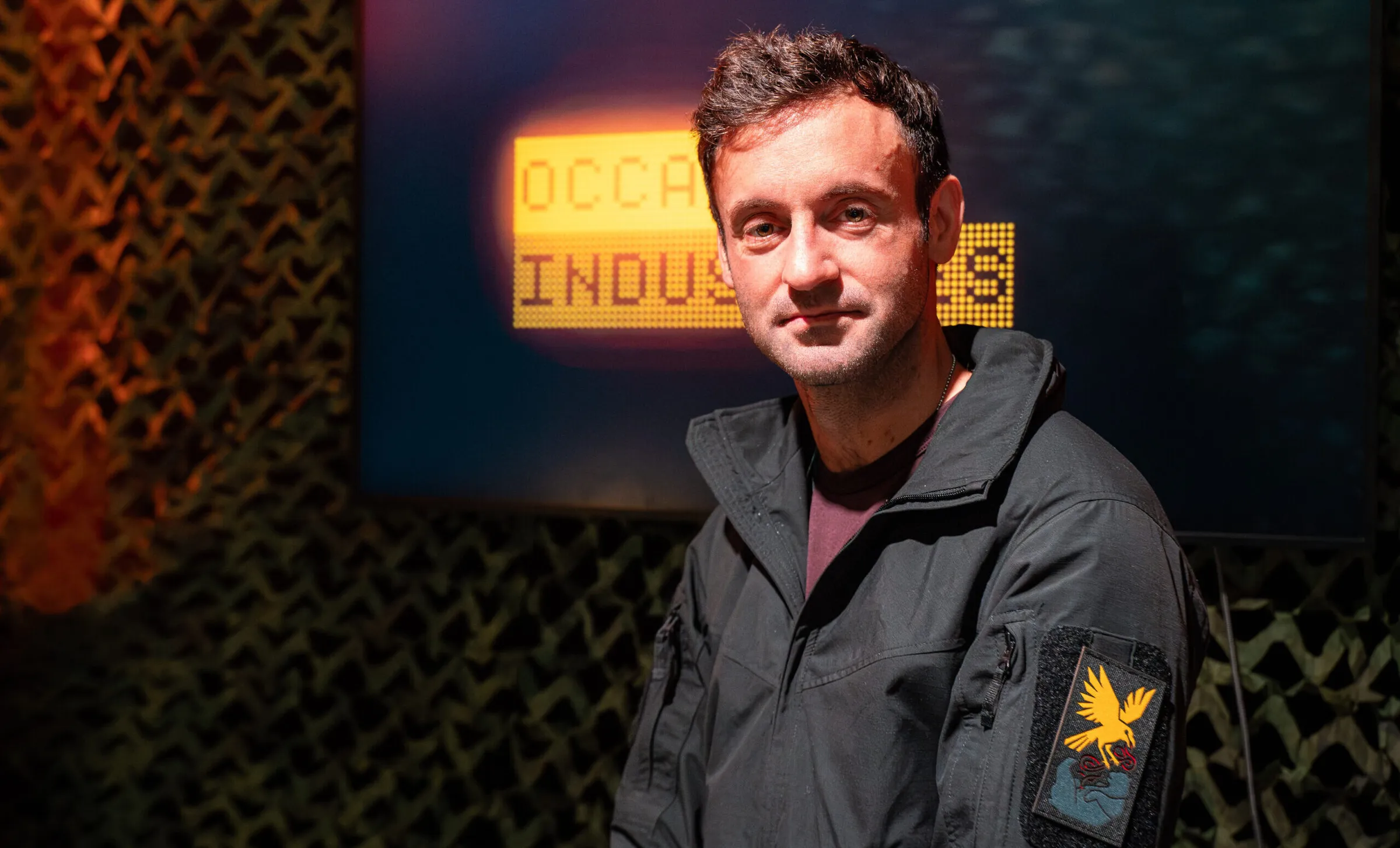
Translated from the German original interview:Reviewed by the Unmanned Magazine editorial team.
Occam develops software intended to enable drones to act autonomously, independent of their manufacturers. At the Future Forces Forum 2026, Gui Wainwright, co-founder and CEO of Occam, explains how cooperation with Ukrainian brigades shapes development, why Europe must procure more than aircraft and who should regulate autonomous systems.
Mr Wainwright, how did Occam come about, and which problem did you initially want to solve?
I have been working with artificial intelligence (AI) and machine learning in various fields of application for about 20 years. Through contacts I learned about the problems the Ukrainian drone programme was having with jamming, loss of connection and interference. Many drones did not complete their mission. That meant economic losses, but above all a lack of effect in operations. The obvious question was whether autonomous drones could help here. I spoke with Ukrainian brigades and first wanted to understand why this problem had not yet been solved. After all, I was not the first person to think of automating drones.
With what result?
It became clear: the solution not only had to work, it also had to be deployable in large numbers. It had to be economical and compatible with different drones. At the quantities being used, supply chains change constantly. The aircraft differ, but the software should deliver as far as possible the same result for the soldier. That gave rise to our approach: common software for drones from different manufacturers. The soldier switches the system on, sets a mission, and the drone carries it out. That can be reconnaissance, searching for infantry, engaging a tank or delivering a medical supply package.
What does that mean technically and economically?
If a drone costs 500 US dollars but needs additional computing hardware costing 5,000 US dollars for its autonomy, the numbers do not add up. That is why it was decisive for us to be able to run the AI on inexpensive hardware. Our software works with computing equipment in the order of about 20 to 50 US dollars. With it, we want to enable drones from different manufacturers to fly autonomously. For the user, the behaviour should remain as uniform as possible, even when using aircraft from different suppliers. Some brigades also see it as a backup for missions that are fundamentally controlled by humans: if the connection is lost, the software should be able to take over. Our aim is to make this capability available in very large numbers and later to transfer the experience gained to other platforms as well.
Is the software already in use?
It is already being used in the war in Ukraine. We work closely with partner brigades. Every improvement, every new version and every new function goes directly to these brigades for testing. Not everything works straight away. That is part of it: we keep developing continuously.
What is the scale of use so far?
For the fourth quarter of this year alone, more than 45,000 drone licences have been requested by Ukrainian brigades. This number is growing. In the long term, we want to deploy our software on millions of drones. For that, it has to remain practicable in terms of both cost and integration.
One can imagine that the system is constantly under development, right? How does experience from the front now find its way back into development?
Yes, exactly. At the beginning I travelled to the brigades at the front myself. I still do that. In the meantime, we also have team members who stay with brigades permanently and collect feedback. We receive a lot of data from the flights. When no communication with a drone is possible, we also draw on observations from other reconnaissance drones and on reports. This information feeds into the further training of our systems. With additional partner brigades, manufacturers and missions, our base of experience is growing too.
The development of drones and of counter-unmanned aircraft systems (counter-UAS) measures is continuous. How do you deal with these dynamics?
Right. What really matters is not only the amount of data, but also the speed of adaptation. A new capability can provoke a response from the adversary after about three months. Then you have to change something again. Our feedback loop is two weeks. Anyone who needs six months or several years for an adaptation will not keep up with this pace. The adversary reacts to known capabilities, so we too have to be able to react quickly.
Can you give an example of how a requirement becomes a new capability?
About a month ago, a brigade came to us together with a manufacturer we had not worked with before. The brigade wanted to achieve a particular effect autonomously, also at night. The hardware was available. They were already trying to solve the task manually, but not successfully enough.

Within two weeks we had taught our AI this new concept, installed the software on the manufacturer's platform and tested it on our test site. Two weeks later, the capability was used in combat.
Unthinkable in a classic procurement cycle …
We have a long list of such requirements. In doing so, we concentrate on the immediate needs at the front: where can we make a particularly big difference with a rapid adaptation? At the same time, we want to develop our technology into a platform with which brigades and manufacturers can increasingly make such adaptations themselves. We must not become the bottleneck. The aim is for an idea for a new capability to be tested quickly and brought into use.
What consequences does this speed of development have for European armed forces?
I consider the notion that Europe must above all buy drones to be dangerously oversimplified. Of course drones should be procured. But the answer is not simply to buy drones.
But rather?
One essential question is: what are these drones supposed to do? A drone does not exist on its own. It needs a supporting system of sensors, situational reconnaissance, manufacturing, payloads and munitions, training, operational organisation and supply. The question of how power is brought forward is also part of it. Our software is only one part of this. Autonomy alone does not yet make an effective military capability. A group of soldiers with drones will not work miracles. Only when sensors, command, tactical understanding and the other prerequisites come together does a capable combined system emerge.

What are currently the biggest challenges for Occam?
As a company we are about one year old and are constantly learning. That concerns the way our AI flies and works, as well as its tactical behaviour and target selection. We have also started carrying out interception and long-range strike missions. So there is still a great deal to develop. We therefore break this large task down into concrete requirements: what does a brigade need now? Which improvement can be implemented quickly? Where can it open up a new capability?
What essential questions does this raise for Europe?
There are several. How do you train soldiers for a technology that changes at this pace? How do you integrate it into command structures? And how do you create the regulatory conditions for it? These questions must be answered at the same time as the technical development. Europe must therefore listen to Ukraine at the level of capabilities, planning and strategy. There is a willingness there to pass on experience. Companies like us, which work both at the Ukrainian front and in Europe, can also convey insights. But this conversation must go beyond the mere procurement of aircraft.
In Europe, regulation seems to play a weighty role in planning and administration. In your opinion, who should determine what autonomous systems are allowed to do, and where their limits lie?
In my view, one of the biggest challenges in Europe will be the legal level. We talk to defence ministries that want to adopt such capabilities but do not yet know how to fit them into their rules of engagement. Technically, integration is often easier for us than clarifying these questions. I do not think it is right for technology companies to impose their moral views on others. It should not be Occam that decides how a state wages war. That is why we do not set these limits ourselves. We provide tools with which defence ministries can set their own limits and adjust them when legal or political requirements change.
So cooperation between companies and state bodies is not a luxury but a necessity?
Yes, we need this cooperation with government decision-makers. The questions are difficult, but we have to answer them. On the other side, someone is also working on such capabilities, possibly without the same ethical and democratic constraints.
Photo credits
© Occam · © Militär Aktuell/Bendl
Continue exploring

Sea drones from Ukraine hit corvette “Merkuri” in Benghazi and freighter “Ascalon” off Libya

Drone strikes on Russia hit oil and missile industry in Magyar's autumn offensive

Fixed-wing drones and satellites: TRL Defense on networked reconnaissance

Alabuga drone hub takes in workers placed by Ghana and DR Congo for Russia's attack drones
