





Camcopter S-100 as a mothership: Schiebel and OSIRIS release a drone in flight
Schiebel's unmanned helicopter released a smaller drone in flight in Austria and relayed its link. The Camcopter S-100 could thus carry interceptor drones and loitering munitions into the area of operations in future; armed tests have not yet taken place.
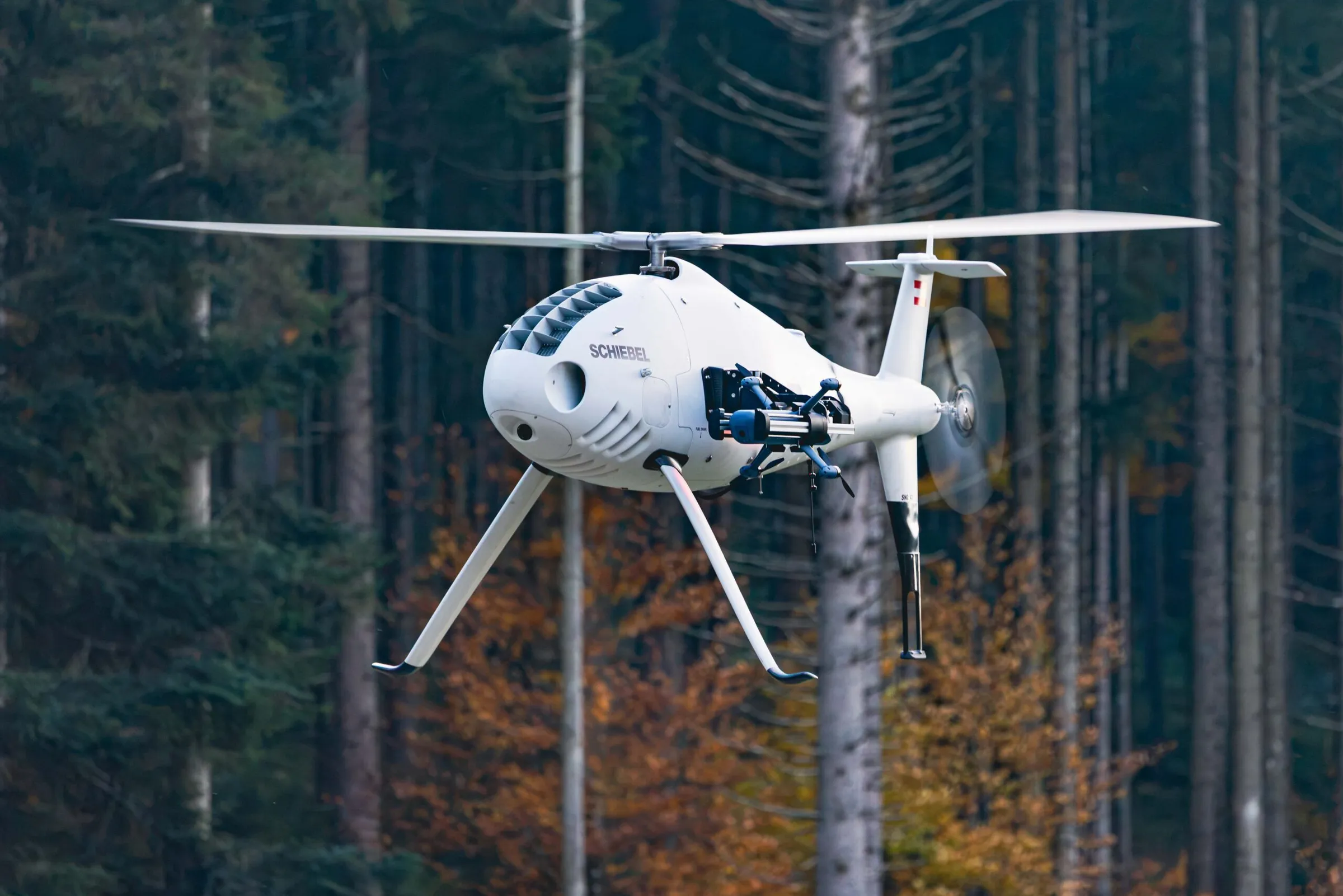
A drone that launches a drone: together with the Polish company OSIRIS, the Austrian unmanned aircraft systems (UAS) specialist Schiebel has tested a new operational concept for the Camcopter S-100. During trials in Austria, the unmanned helicopter released a smaller drone in flight and then took over its communications link. In future, the Camcopter could therefore also serve as an airborne launch platform for interceptor drones and loitering munitions.
The centrepiece of the demonstration was the HSCD-1 (High-Speed Camera Drone), a high-speed drone from OSIRIS. The Camcopter S-100 carried it and released it in forward flight. It was then controlled via a link that the S-100 relayed as an airborne relay station.
For the first time, the two companies thus showed how an airborne carrier platform, drone launch and communications relay work together. The larger platform brings the smaller drone closer to its area of operations and maintains the link even after release.
More range for small drones with the Camcopter S-100
In this concept, the range and endurance of the Camcopter meet the speed and agility of smaller unmanned systems. According to Schiebel, this significantly increases their operational radius and flexibility without relying on ground-based launch and communications infrastructure.
The approach is of particular interest for counter-UAS. While an unarmed test drone flew in the demonstration, fast interceptor drones with suitable effectors or loitering munitions could also be launched from the Camcopter in future.
According to Schiebel, the concept is not to remain limited to the S-100. It could also be transferred to the other models S-300, S-101 and S-301.
“This proof of concept demonstrates the enormous potential that arises from combining the proven Camcopter with smaller, specialised unmanned systems,” says Hans Georg Schiebel, Chairman of the Schiebel Group. The successful integration of the HSCD-1 shows an approach that can also be transferred to fast interceptor drones, he said.
Focus on military applications
The test fits the Austrian company's stronger focus on the military. Last year Schiebel had already presented the Camcopter S-101 and S-301, two new platforms designed specifically for armament. Both systems were developed from the ground up for military requirements and are intended to enable AI functions, robust communications architectures and the integration of guided weapons, among other things. Schiebel is thus responding to growing global demand for armed and autonomous drone systems.
The mothership concept now demonstrated expands the possible roles of the Camcopter family once again. In future, the unmanned helicopters would not only carry their own sensors or effectors, but could also bring smaller, specialised drones into the area of operations and support their missions from the air.
For now, however, this remains a proof of concept: what was shown was the release of an unarmed drone and the subsequent communications link. Actual use of armed interceptor drones or loitering munitions was not demonstrated in the tests.
Photo credits
© Schiebel
Continue exploring

Sea drones from Ukraine hit corvette “Merkuri” in Benghazi and freighter “Ascalon” off Libya

Drone strikes on Russia hit oil and missile industry in Magyar's autumn offensive

Fixed-wing drones and satellites: TRL Defense on networked reconnaissance

Alabuga drone hub takes in workers placed by Ghana and DR Congo for Russia's attack drones
