





Drone attacks on refineries: Ukraine strikes Russia's oil industry in the hinterland
Kyiv aims to hit the Kremlin's war financing and is relying on drone attacks against refineries, fuel depots and oil terminals deep inside Russia. At the same time, images of a previously unknown Ukrainian drone type have emerged.
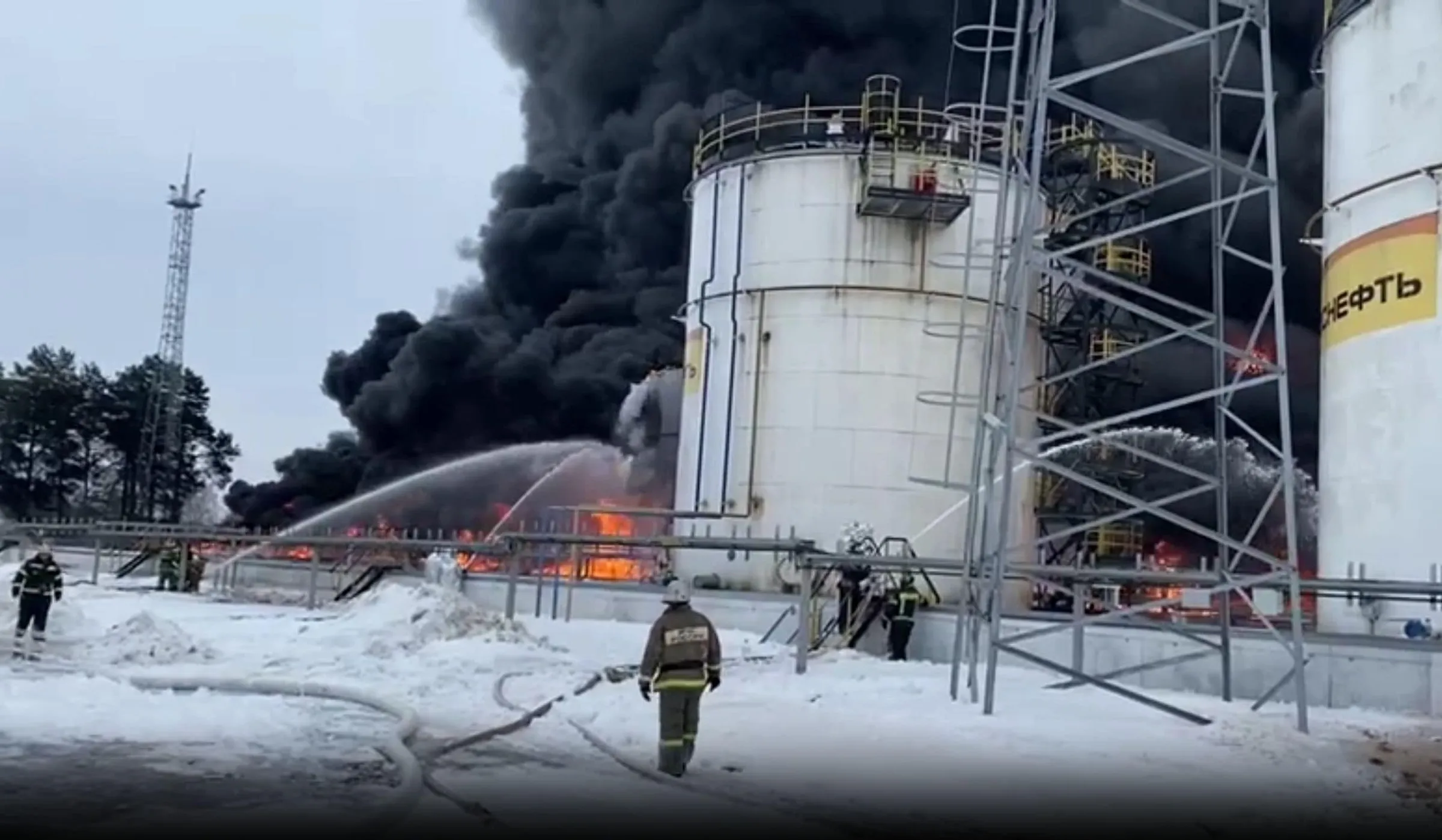
Ukraine is using drone attacks on a broad front to strike Russia's oil and gas industry, the most important pillar of the Russian economy. The drone attacks of recent weeks have set several refineries and fuel depots across the country on fire.
Before Russia's war of aggression against Ukraine began in February 2022, almost 50 per cent of Moscow's export revenue came from the energy sector, that is, from oil, gas and coal. International sanctions then forced Moscow to reorganise its export routes: direct deliveries to Europe fell drastically, while exports to India in particular grew considerably. The sanctions are also repeatedly circumvented, for example when ship-to-ship transfers between tankers at sea are meant to disguise the origin of the oil.

Despite some difficulties, the oil and gas industry remained a key source of revenue for the Kremlin and thus also a source of funding for the war of aggression. This is exactly where Kyiv is targeting: to restrict this funding, Ukraine has for several weeks been deliberately attacking refineries and fuel depots, including deep in the Russian hinterland. An overview of the targets so far:
Drone attacks from Oryol to Ust-Luga
- 9 January: At the Oryolnefteprodukt oil depot in Oryol Oblast, a drone struck a tank.
- 18 January: Debris of a drone was found on the site of the St Petersburg oil terminal in Leningrad Oblast.
- One day later, a drone caused a major fire at an oil depot in Klintsy in Bryansk Oblast. The depot is one of the important transit hubs through which fuel and lubricants for the needs of the Russian troops are transported.
- 21 January: Two drones hit the Ust-Luga oil and gas complex, which belongs to the Russian company Novatek. It lies on the Baltic coast around 100 kilometres west of St Petersburg and about 900 kilometres from Ukraine. The attack deliberately targeted the terminal of the gas liquefaction plant, an infrastructure that serves the export economy 100 per cent. Naphtha and kerosene from Ust-Luga go mainly to the main customers Singapore, Turkey, Taiwan and China.
- In the night of 24 to 25 January, Ukraine attacked the Rosneft refinery in Tuapse on the Black Sea, which also works entirely for export. The primary processing unit for petroleum products took a direct hit. This is notable because refineries appear to laypeople to be easy targets owing to their size. What matters, however, is to hit precisely those areas within the plant whose failure shuts down as much of the production as possible. One example: destroyed storage tanks can be disconnected relatively easily and, if necessary, bypassed fairly quickly with new pipelines. The “cracker”, the part of the plant that separates crude oil into its components, is a different matter: if it is damaged, the refinery has to stop operations entirely.
- On 29 January at 06.39 the Slavneft-Yanos oil refinery in Yaroslavl was hit. This attack was apparently not successful; afterwards, however, images emerged for the first time of a previously unknown type of drone that had apparently been used. According to Mykhailo Evraev, governor of Yaroslavl Oblast, an electronic warfare (EW) system at the refinery is said to have prevented the drone attack. The plant is located around 240 kilometres north-east of Moscow and thus more than 700 kilometres from Ukraine.
- Two attacks followed in the night to 31 January: the one on the Kstovo refinery in Nizhny Novgorod Oblast failed, while the St Petersburg oil terminal was hit once again.
- In the night to 3 February, according to local witnesses, two drones struck the Lukoil refinery near Volgograd (formerly Stalingrad). No plant in south-western Russia produces more petroleum products than this giant refinery. It lies directly on the Volga and is connected straight to the world market via the Volga–Don Canal, the Sea of Azov and the Black Sea. The strike hit the Elou-Avt-5 distillation unit, which had only been newly opened in December 2022 and has a capacity of 3.5 million tonnes per year. The refinery as a whole has a capacity of 15.7 million tonnes per year.
A new strategy focused on oil exports
Ukraine already attacked Russian refineries and fuel depots in 2022, but at that time in the wider area of the theatre of war and clearly with the aim of reducing the fuel available to Russian troops in Ukraine. The current concentration of the attacks on the oil export industry is a new strategy.
The figures for 2023 show how important Russia's oil ports are for the export economy: 30 million tonnes of oil products were exported via Novorossiysk (Black Sea), 44.4 million tonnes via Primorsk (Baltic Sea), 34 million tonnes via Ust-Luga (Baltic Sea) and 42.8 million tonnes via Kozmino (Sea of Japan near Vladivostok). All four export routes recorded growth of between 3.1 per cent and 9.4 per cent. On average, oil exports via Russian ports rose by 7.2 per cent in 2023 compared with 2022.

Unknown drone type over Yaroslavl
With the attack on the refinery in Yaroslavl on 29 January, images of a new Ukrainian drone type that appears to be used in long-range attacks reached the public for the first time. They show a drone with a square fuselage cross-section which, at first glance, hardly seems capable of flying really long distances. The straight wings have a clearly visible camber and a large chord, as well as endplates that reduce induced drag. The design is intended for high lift at low speeds. It is vaguely reminiscent of the PC-6. One exception is the V-tail: it appears to be of lighter construction and is therefore likely to generate less drag than a conventional tail.
Based on the truck tyre tracks visible in the image, the wingspan can be estimated at 2.5 metres to 2.75 metres and the fuselage cross-section at around 30 x 30 centimetres. In terms of internal volume, tanks in the fuselage and wings in the order of 80 to 90 litres would be possible. Propulsion is presumably a piston engine with a propeller; however, there is no image of it. Russian sources speak of only a very small warhead weighing three kilograms. With engines of around 25 hp that consume about six litres per hour in economical operation, the necessary range would be achievable.
There is no information at all on the drone's sensors. Because the attacks take place at night and the refineries' distillation units reach temperatures of several hundred degrees, the use of infrared sensors is conceivable.

Fuel as a weak point
Reports of the Ukrainian drone attacks almost inevitably invite comparisons with the Allied bomber offensive against the German fuel industry in the Second World War. From May 1944 until the end of the war, the Allied air forces continuously attacked German fuel targets. Refineries, benzene plants, hydrogenation plants and oil depots were bombed. As a result, the Wehrmacht and the Luftwaffe lost their fuel supply, the German fuel industry collapsed, and the attacks helped to bring the war to a quicker end.
Only the future will show whether Ukraine can expand its drone offensive against key Russian industries far enough to achieve a similar effect. It is very likely, however, that Kyiv will continue its currently so successful strategy in the coming weeks; in any case, the course towards more intensive drone attacks is set. In 2023 the Ukrainian military approved a total of 67 new drone models and awarded production contracts for 58 of them. Around 200 Ukrainian companies offer services and products in this field, and all have been tasked with scaling up in 2024. Ukraine has set a production target of one million drones for 2024.
Russia, for its part, also repeatedly attacks Ukraine's oil industry: since 2022 there have been regular attacks on Ukrainian refineries and fuel depots.
Photo credits
© Archiv
Continue exploring

Mine countermeasures with unmanned systems are changing maritime warfare

Drone protection strategy assigns responsibilities and procurement goals
Reconnaissance drones from Ukraine to be built in Germany with EUR 34 million
Unmanned ground vehicles from ARX Robotics join British Asgard network
