





Мовою «Українська» поки що недоступно — ви читаєте англійське видання.
Drone pilots in competition: British Army puts teams to the test at Wellington Barracks
Ten hours, 30 teams of four, a replica battlefield: in Westminster the British Army tested how its drone pilots perform under realistic conditions. The trophy went to the Royal Yorkshire Regiment.
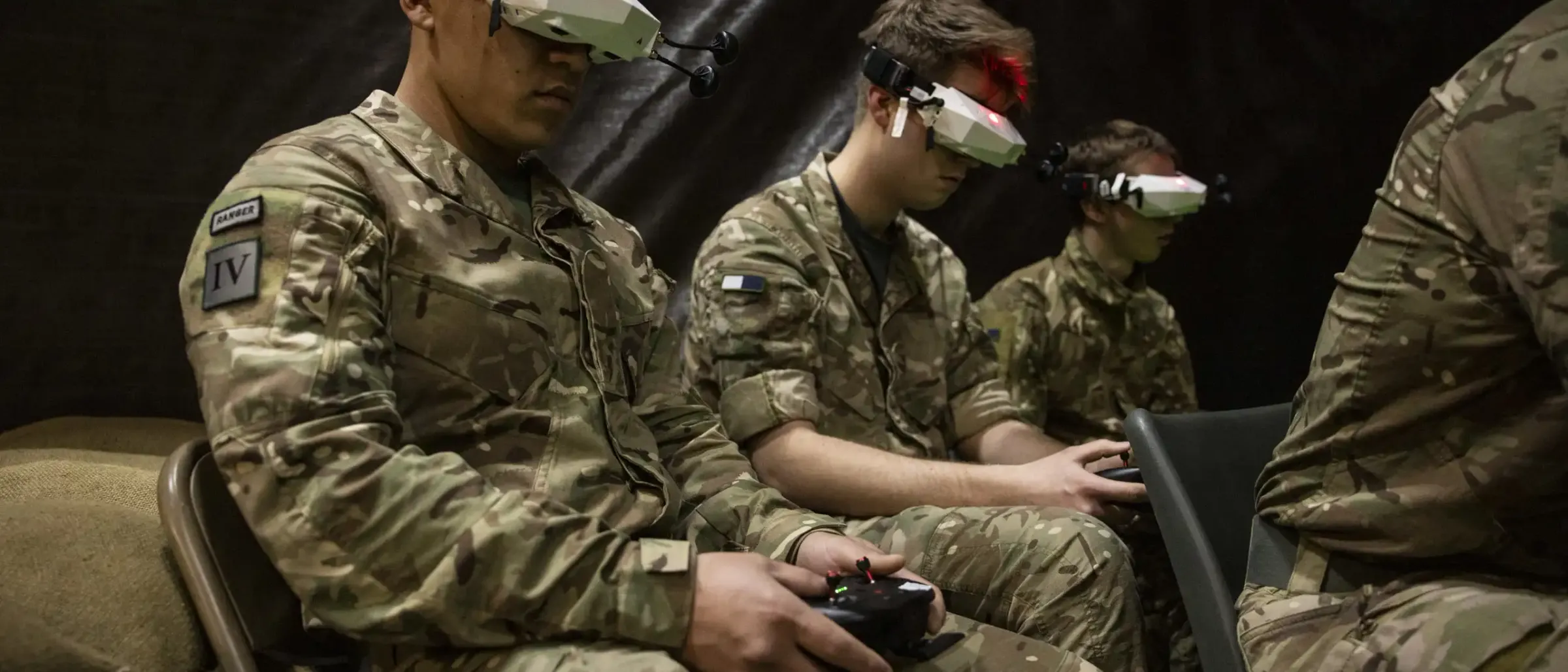
The British Army pitted its best drone pilots against each other in the darkened rooms of Wellington Barracks in Westminster. It wanted to find out who would hold their own best on the battlefields of the future. All units of 1 UK Division, the Army's Global Response Division, from across the United Kingdom were invited to take part in the ten-hour drone competition. For the first time, the course resembled a modern battlefield in a war-ravaged city.
A total of 30 teams of four competed, equipped with state-of-the-art hydrocarbon first-person view (FPV) drones and point of view (POV) headsets. In the first part, they raced each other through a complex battlefield of destroyed buildings and damaged vehicles. In pitch-dark night, the teams then made their way through sandbag-lined trenches before finding themselves in a scenario in “enemy territory”. There they carried out reconnaissance together, gathering as much information as possible before safely recovering their drone from the area.


Drone pilots: from hobby sport to operational capability
In modern warfare, the use of drones has changed the dynamics of military operations: it provides unique tactical advantages and increases soldiers' operational efficiency in a range of combat scenarios. Armies worldwide use drones for a wide variety of purposes, including surveillance, reconnaissance and targeted strikes. The British Army is therefore considering how a much broader range of soldiers can employ drones.
Drone competitions have been held in the British Army before, but they were always regarded as a hobby sport. Current conflicts have changed this view considerably: an estimated 80 per cent of battlefield casualties in Ukraine are attributed to drone activity. Skilful use of drones can therefore be the key to operational success.

The competition was therefore deliberately held in a highly realistic combat scenario. This was intended to let soldiers fully engage with drone flying as a possible future operational capability rather than seeing it merely as a competitive sport. As a result, the competition proved more interesting and exciting than before.
Time limit, CCTV and a trophy
Anyone hoping for first place had to complete the tasks within a time limit – speed as well as precision was required. Using specific vantage points and CCTV, the teams followed their competitors' progress. In the end, the team from the 2nd Battalion of the Royal Yorkshire Regiment prevailed; the prestigious trophy was presented by Brigadier Mark Berry, commander of 16 Air Assault Brigade. The 2nd Battalion of the Parachute Regiment came a close second, and third place went to the Grenadier Guards.
Автори фото
© Ministry of DefenceЧитайте також

Морські дрони з України уразили корвет «Merkuri» у Бенгазі та вантажне судно «Ascalon» біля Лівії

Удари дронів по Росії вражають нафтову і ракетну промисловість під час осіннього наступу «Мадяра»

БпЛА літакового типу та супутники: TRL Defense про мережеву розвідку

Безпілотний бойовий літак Kizilelma на озброєнні Туреччини: Baykar передала перші три
