





Counter-drone defence and drones: what the Austrian Armed Forces need
In an interview, Brigadier Erich Weissenböck and Colonel Klaus Strutzmann of the Austrian Ministry of Defence talk about the growing importance of drones, the challenges of counter-drone defence and the long-term adjustments to Austrian air defence.
Translated from the German original interview:Reviewed by the Unmanned Magazine editorial team.
In an interview, Brigadier Erich Weissenböck, Head of the Structural Planning Division at the Ministry of Defence, and Colonel Klaus Strutzmann, Head of the Air Capability Management Branch in the Structural Planning Division, talk about the growing importance of drones, the challenges of counter-drone defence and the long-term adjustments to Austrian air defence.
Brigadier, Colonel – drones play a very central role in the armament and upgrade plans of the Austrian Armed Forces (Bundesheer), don't they?
Weissenböck: Yes, because drones have fundamentally changed the capabilities of our own troops and of the adversary. We see systems in all size classes, from the improvised first-person view (FPV) quadcopter to the medium-altitude long-endurance (MALE) drone, which, compared with manned systems, perform reconnaissance and fire-support tasks for ground forces at low cost. In this context, the use of systems available on the civilian market, or the production of systems based on civilian components, must be taken into account. The use of drones thus makes it possible to increase the survivability of troops on the battlefield and to ensure command superiority.
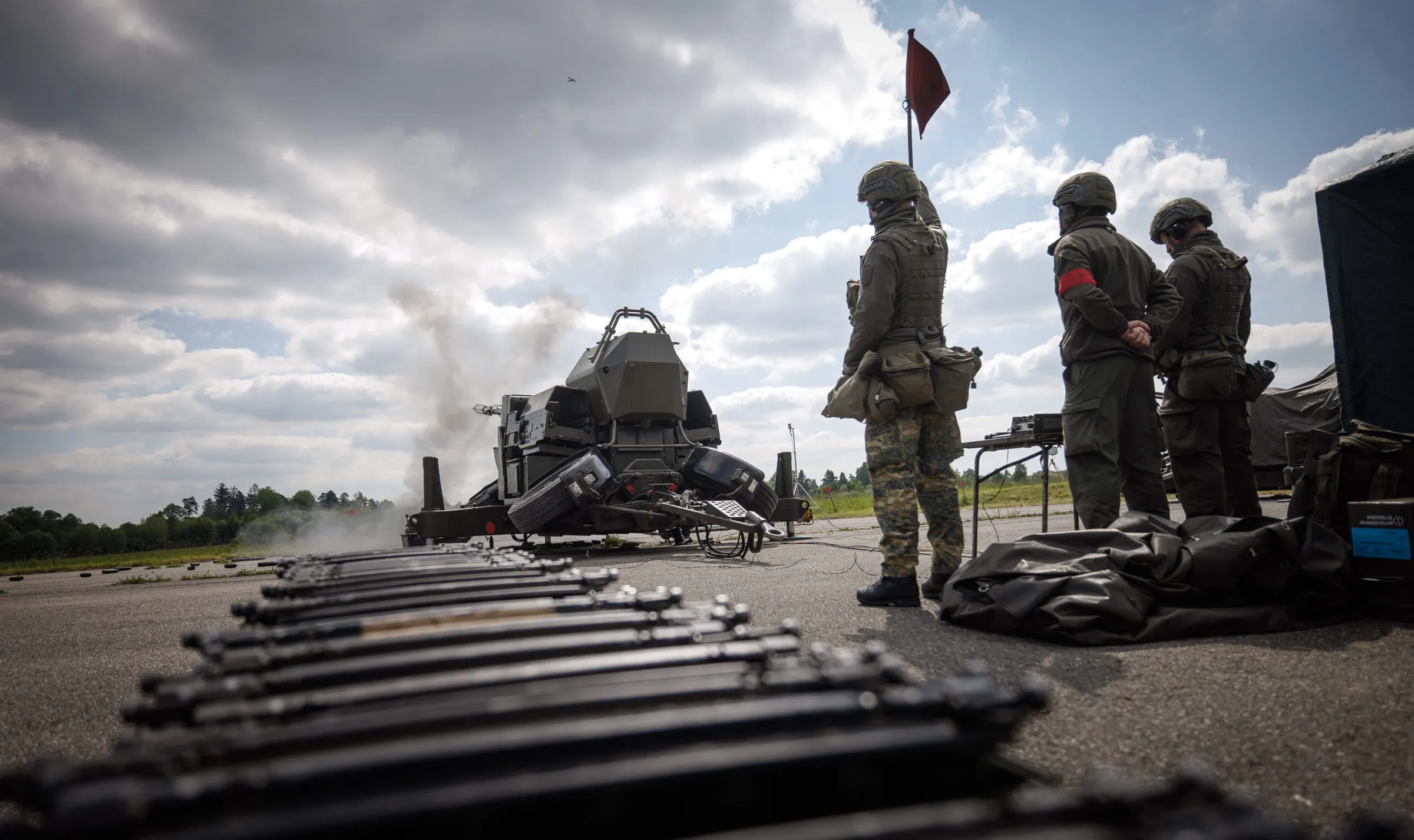
Strutzmann: On the other hand, the adversary's use of drones forces us to ensure appropriate countermeasures. Saturating air defences through the massed use of aircraft is fundamentally not a new concept, but with drones it can be achieved cheaply and in large numbers. Air defence must be enabled to engage drones of all sizes at all altitudes with suitable effectors. In addition, every unit must be enabled, within the framework of all-arms counter-drone defence, to defend against drones – particularly at low altitude.

That sounds like a paradigm shift. What does it mean for concepts and structures?
Weissenböck: The security situation has changed dramatically. The Bundesheer must become capable of defence again. As part of capability development, all lines of development are being assessed, from organisation and structure, equipment and the necessary training through to infrastructure. The focus is on building up capabilities rapidly. The necessary planning documents must therefore be available promptly.
Strutzmann: The networking of systems is becoming even more important in this context. It can no longer be about individual stand-alone solutions, but about an integrated overall system that condenses situational pictures and enables the commander to make the right decision within seconds.
Is classic air defence sufficient for this, or are completely new approaches needed?
Strutzmann: In principle, classic air defence is equal to the task if appropriate means such as gun and missile systems with different ranges are available. Defending against small drones naturally places high demands on the sensors needed for detection and on the effectors for engagement. All experience from Ukraine shows that there can be no single solution. Guns alone are not enough, and neither are missiles alone. Electronic warfare measures remain important, and in future lasers too. The point is to combine effectors intelligently and bring them together in a single, rapidly reacting command architecture.
Weissenböck: And one must not forget: airmobile assets will also be part of this counter-drone defence. In certain scenarios an aircraft can be employed just as effectively as a ground-based system. But what remains decisive is that all components interlock.
How do you deal with the mass of drones that can potentially be deployed at once? In Ukraine we are seeing Russian attacks with around 1,000 drones at a time, and one hardly needs to be a prophet to foresee attacks with 1,500, 2,000 or 3,000 drones.
Strutzmann: That is correct, and effective engagement in such cases is only possible if different effectors are available in the required numbers. The cost of the countermeasures naturally also plays a role. One should not waste an expensive missile on a cheap drone if cheaper systems can ensure the defence. What is needed, therefore, are graduated means matched to the threat, and a robust command system that mediates between these options as automatically as possible. Speed, networking and prioritisation are decisive.

“The security situation has changed dramatically. The Austrian Armed Forces must therefore become capable of defence again.”
Brigadier Erich Weissenböck,
Head of the Structural Planning Division at the Ministry of Defence
So a multi-layered system?
Strutzmann: Yes, as already mentioned – there is no other way. In this multi-layered approach every effector and every system will have a very specific task, and an effective defence will only be possible if these effectors and countermeasures are sensibly harmonised and coordinated with one another.
What does all this mean for the troops on the ground? How can soldiers in the field protect themselves?
Weissenböck: There, too, the multi-layered approach is needed. In future every combat and support formation will have to have its own elements specialised in counter-drone defence. In practice, these are small mobile teams with sensors and effectors that are integrated into the command and information system. At the same time, every section and every company needs a form of self-protection that makes it possible at least to detect and counter threats.
Defence concerns not only the battlefield but also infrastructure.
Strutzmann: Correct. A guard with an assault rifle is no longer sufficient today to protect infrastructure. Barracks and critical sites need sensors, protective measures and drone detection. These requirements must be taken into account when planning properties and building infrastructure. This also concerns legal frameworks and procedures: who may intervene and when, how do we respond to unclear threat situations? All this must be regulated in good time.
How important is international cooperation in this?
Weissenböck: Very important. We exchange views in NATO working groups, use the opportunities offered by European projects and cooperate closely on a bilateral basis with the German Bundeswehr and the Swiss Armed Forces. Compatibility is decisive – both technically and organisationally.
Strutzmann: Shared situational pictures and coordinated procedures are indispensable. Only these make it possible to defend against long-range weapon systems, given the necessary warning time.

“There can be no single solution. Guns alone are not enough, and neither are missiles alone.”
Colonel Klaus Strutzmann, Head of the Air Capability Management Branch
in the Structural Planning Division at the Ministry of Defence
Which technological trends will be decisive in future?
Strutzmann: Besides new effectors such as lasers or advanced electronics, above all anything that improves reconnaissance and command capability. The better the situational picture, the more precisely and quickly effects can be delivered.
Weissenböck: What matters is not to assess new technologies in isolation but as part of the overall system. When describing the tactical functional requirements of systems, attention must be paid to what genuinely relieves and protects the soldier. Systems that make operations more complicated have no future.
How far along is the laser defence you mentioned?
Strutzmann: Tests are increasingly promising. We therefore assume that in the foreseeable future we will gain a new technology with potential particularly for defending against micro drones.
The Bundesheer is currently pursuing its build-up plan “Bundesheer 2032+”. What will counter-drone defence look like at the end of this period?
Weissenböck: By then we want to have built up a graduated counter-drone defence out to medium range, extending from anti-aircraft guns to anti-aircraft missiles. These systems will be complemented by electronic warfare assets and interceptor drones. Battle management systems are already being introduced. By 2032, counter-drone elements will be established in the units. The goal is a force that understands counter-drone defence as a natural part of how it fights.
Strutzmann: What will be decisive is that we take counter-drone defence into account in operational planning from the outset – not as an add-on, but as an integral component. Only in this way will we be compatible within Europe and at the same time able to defend our country independently.
Photo credits
© Bundesheer/Trippolt · © Bubu Dujmic
Continue exploring

Loitering munition Virtus from Stark: 45th Armoured Brigade “Litauen” tests it at “Freedom Shield 2026”

Drone stations for maritime surveillance: Rift begins tests off the French coast

Sea drones for the Baltic: Sweden buys surveillance from Saildrone as a service

Maritime drones: Eviden unveils SMX, an electromagnetic navigation sensor
