





Counter-drone defence with the F-16: Ukrainian squadron has shot down more than 1,000 Russian drones
A deputy squadron commander with the call sign “AB” tells the Mitchell Institute how Ukraine uses the F-16 for counter-drone defence, why dispersed basing works and what support is still missing.
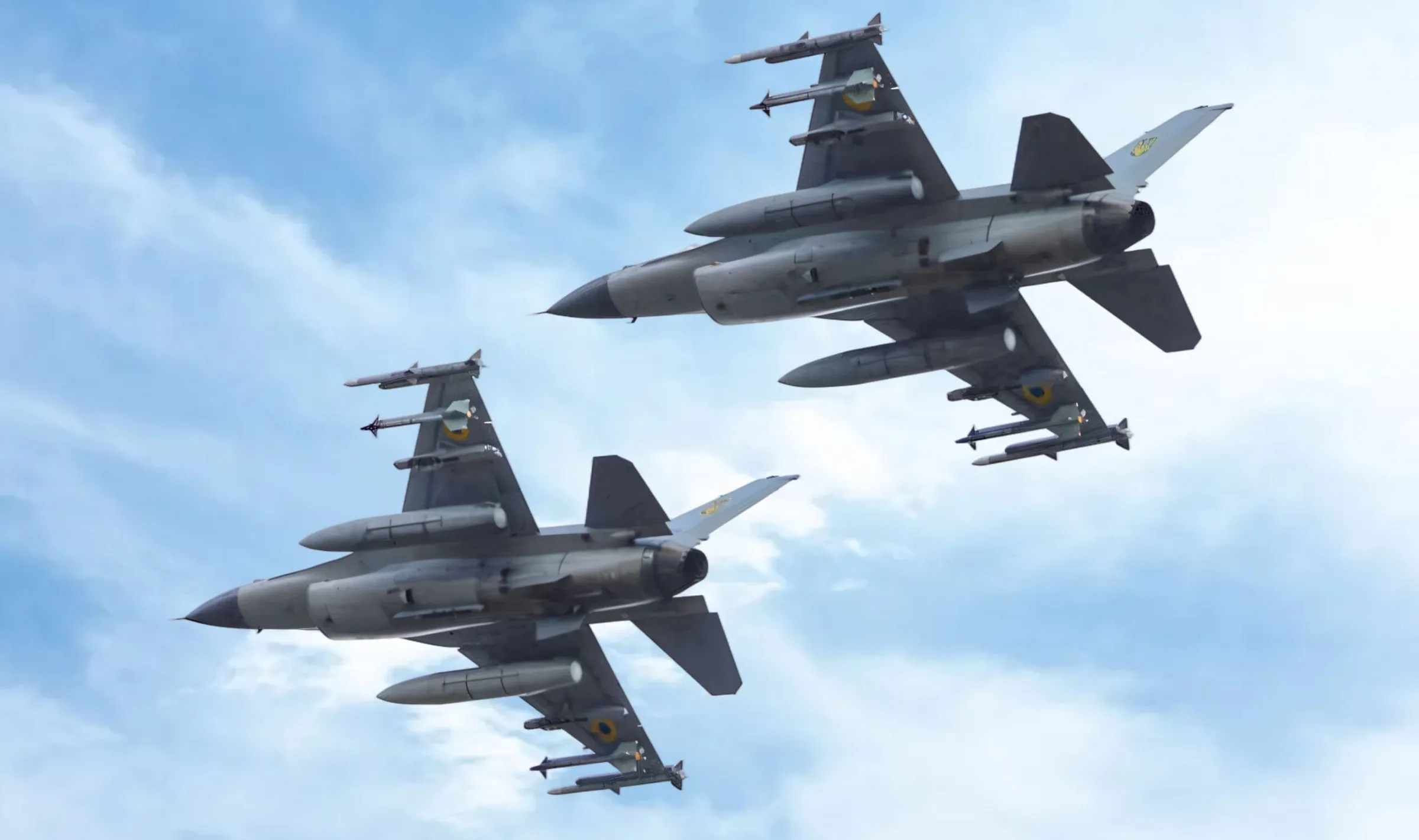
More than 1,000 Russian Shahed-type drones and cruise missiles shot down are now credited to the Ukrainian airmen who include a fighter pilot with the call sign “AB” – he withholds his name for security reasons. As deputy commander of a Ukrainian fighter squadron, the experienced pilot gave the Mitchell Institute for Aerospace Studies, headed by Lieutenant General (ret.) David A. Deptula (USAF), unusual insights into the ongoing restructuring of the Ukrainian Air Force and into counter-drone defence from the cockpit.
From the MiG-29 to the F-16 cockpit
Long before the Russian occupation of Crimea in 2014, “AB” was already flying Soviet MiG-29 fighter jets. Within the last two years he converted to the F-16 Block 10 and Block 15 supplied by the Netherlands, Denmark, Norway and Belgium.
The pilot is deliberately matter-of-fact about the new aircraft: “It actually works quite well”. Operating conditions are so extreme that they would push even the most modern air forces to their limits – yet the F-16s have passed this test. Compared with the older Soviet types, “AB” says, they offer “significantly improved situational awareness, more modern radar systems, more precise strike capability and greater flexibility in air combat”.

Four out of five missions – counter-drone defence included
According to “AB”, around 80 per cent of all Ukrainian Air Force missions are now flown by the F-16. This speaks for the reliability of the jets as well as for the pilots’ remarkably steep learning curve. His squadron says it has intercepted Russian cruise missiles and Iranian Shahed/Geran drones “in hundreds of missions”. In practice, these systems often behave like precision-guided long-range weapons.
The “Ukraine Falcons” have, however, also suffered three known losses. At the same time, the ageing fleet of MiG and Sukhoi types remains in service, even though problems are growing: spare parts are short, and maintenance capacities in the west of the country have repeatedly been targeted. The West is now increasingly helping out, for example with spare-parts stocks from the “Boneyard” of the US Air Force at Davis-Monthan (Arizona).
Ingenuity instead of a training system
There were no established training systems or on-site technical support. Ukrainian pilots and technicians therefore had to teach themselves in the USA and Romania how to maintain, arm and fly the F-16 effectively. According to “AB”, this produced their own tactics, techniques and procedures intended to increase the jets’ survivability in one of the world’s most dangerous air combat environments.
Dispersed basing on the ACE principle
The basis for Ukraine’s F-16 force is Agile Combat Employment (ACE): flexible basing distributed across many sites (“dispersed basing”) under constant fire. Aircraft and crews continuously move between different, often improvised airfields. This is meant to leave Russian reconnaissance and Russian strikes hitting nothing.
“AB” finds it remarkable that almost four years of Russian missile and air attacks have not completely destroyed or permanently disabled a single Ukrainian air base. Ukraine thus demonstrates the practical effectiveness of ACE more convincingly than any NATO exercise could.

EW as a deciding factor
According to “AB”, aircraft alone have long ceased to decide modern air warfare. Electronic warfare (EW) has become a decisive factor. Russian jamming systems, spoofing (signal falsification) and identity attacks make missions considerably more difficult. “Ukrainian units are therefore constantly working to adapt their EW countermeasures in order to keep the tactical advantage in the electromagnetic spectrum.”
Ukraine as a test bed for future air wars
Deptula’s institute sees Ukraine’s air war as a “living laboratory” from which Western air forces can draw valuable lessons. Tactics are constantly refined there and complex operations carried out without outside help; at the same time it becomes visible how ACE principles work under real war conditions.
“AB” criticises the fact that US and European air forces have so far hardly been able to take part or observe on site. He calls this “A missed opportunity” – after all, Russia is studying Ukrainian tactics and adapting, and China, North Korea and Iran are also learning closely.
Thanks to the USA, need for jets and missiles
At the end of the conversation, “AB” expressly thanked the American people for the support provided so far. The war, however, is “far from won”.
Further resources are needed, he demanded – above all modern EW systems and sustained logistical support. His clear message: “F-16 Block 70 and more missiles. There are so many targets to be taken out.”
Photo credits
© Ukrinform
Continue exploring

Loitering munition Virtus from Stark: 45th Armoured Brigade “Litauen” tests it at “Freedom Shield 2026”

Drone stations for maritime surveillance: Rift begins tests off the French coast

Sea drones for the Baltic: Sweden buys surveillance from Saildrone as a service

Maritime drones: Eviden unveils SMX, an electromagnetic navigation sensor
