





Counter-UAS and swarm reconnaissance: Autonomous Teaming Solutions shows three systems at KSK Symposium
A reconnaissance swarm, a weapon turret against small aerial targets and vehicle protection against FPV drones: ATS, founded in Munich in 2024, equips purchased platforms for reconnaissance and counter-UAS with software, sensors and AI.
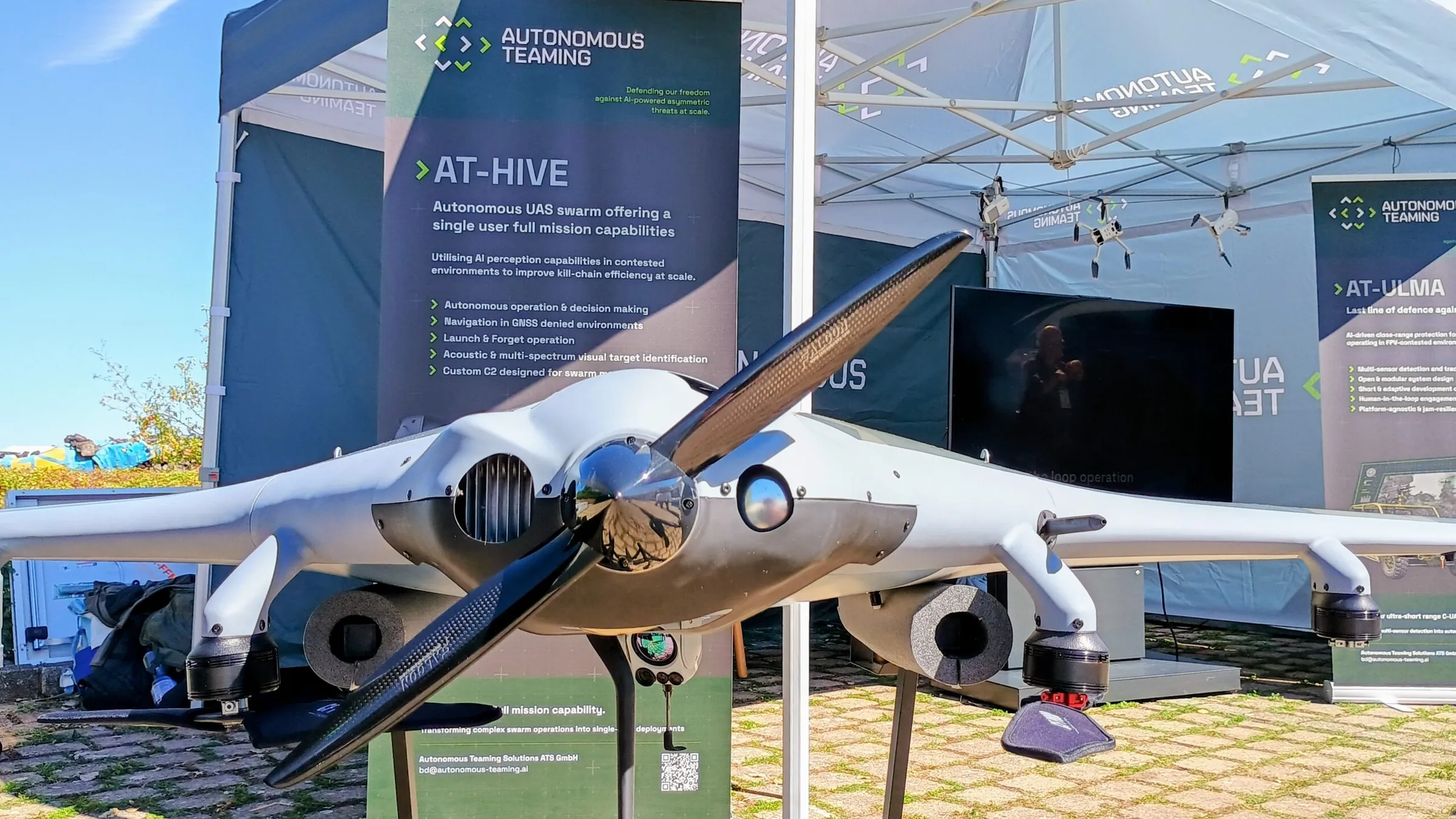
At the KSK Symposium in Germany, Autonomous Teaming Solutions (ATS) presented several systems for unmanned platforms and for counter-UAS defence against small drones. The Munich-based company was founded in 2024. It sees itself as a defence company whose core capabilities are to stem primarily from software, sensor integration and artificial intelligence.
ATS does not build the drone platforms entirely in-house. They are purchased and then fitted with sensors, software and mission-specific components of its own development. Three projects were in the spotlight: AT-Hive as a reconnaissance swarm, AT-Defender as a counter-sUAS system and AT-Ulma as a tactical solution for vehicle protection. Together they cover three closely interlinked fields – reconnaissance in a disrupted electromagnetic environment, defence against small drones and direct protection of mobile platforms.
AT-Hive: a swarm that reconnoitres without constant control
AT-Hive is designed as a self-organising swarm of unmanned aircraft systems (UAS). By fusing visual and acoustic sensor data, several drones are to operate as a group, find enemy targets and send reports.
The system is intended primarily for reconnaissance in areas of operation without access to a global navigation satellite system (GNSS) that are also heavily shaped by electronic warfare – satellite navigation signals such as GPS are jammed, spoofed or entirely unavailable there. In parallel, ATS is planning a robust communications architecture with redundant systems in order to maintain the link as far as possible even under heavy interference.
It is based on a “launch-and-forget” concept: once launched, the swarm is to carry out its reconnaissance task largely autonomously. ATS states an endurance of up to five hours for the systems. AT-Hive could therefore be of particular interest wherever reconnaissance has to be conducted over long periods without an operator constantly controlling each individual drone.
AT-Defender: VSHORAD turret for close-range counter-UAS
AT-Defender is a software-defined air defence weapon turret mounted on vehicles. It is designed as a VSHORAD solution, i.e. for engaging air threats at very short range, with the main focus on small unmanned aerial vehicles.

At its core is 360-degree multi-sensor fusion. It combines three-dimensional tracking of multiple targets, a laser rangefinder and detection with ranging that does not rely on radio frequencies. This is intended to enable AT-Defender to detect threats that emit no radio signals at all or only signals that are hard to analyse. The detection range for drones is given as around 500 metres.
According to ATS, the system needs around 30 milliseconds to classify a target and about 50 milliseconds to establish three-dimensional target tracking. Via its open, API-capable software architecture, AT-Defender is also to be connectable to existing command and control systems. In principle, this allows both operation as a stand-alone capability and integration into existing structures.
The effector is a Heckler & Koch GMG grenade machine gun in 40 × 53 millimetre calibre. Together with airburst ammunition from Rheinmetall, small aerial targets are to be engaged via a programmed burst point. Fast sensors, automated target tracking and a powerful kinetic effector are thus combined for close-range defence against drones.
AT-Ulma is to keep tactical vehicles mobile
AT-Ulma is of particular interest for fast and specialised forces. The system is intended for close-in protection of tactical vehicles in an area of operations dominated by first-person view (FPV) drones. The platform is to remain mobile so that the mission can continue even under immediate drone threat.
Several components interact in AT-Ulma: a multi-sensor system autonomously handles the detection and tracking of threats. In addition, there is a robotic weapon station and a kinetic effector – in the current configuration a Benelli M4 semi-automatic shotgun.
Detection out to 100 metres is currently planned. A human operator still confirms before any engagement. The system is thus based on a “man-in-the-loop” approach: while sensors and software are to support the operator in target acquisition and tracking, the human makes the final decision on engagement.
According to ATS, a first trial was carried out around two months ago. Development of the system has not yet been completed.
Photo credits
© Militär Aktuell/Bendl
Continue exploring

Loitering munition Virtus from Stark: 45th Armoured Brigade “Litauen” tests it at “Freedom Shield 2026”

Drone stations for maritime surveillance: Rift begins tests off the French coast

Sea drones for the Baltic: Sweden buys surveillance from Saildrone as a service

Maritime drones: Eviden unveils SMX, an electromagnetic navigation sensor
