





Military drones from China: KZ-2 from the Chinese Academy of Sciences appears in Changchun
Only a few weeks after the victory parade in Beijing, the KZ-2 reveals another previously unknown type of Chinese military drone. Its purpose and development status are unclear – but its two engines are a novelty.
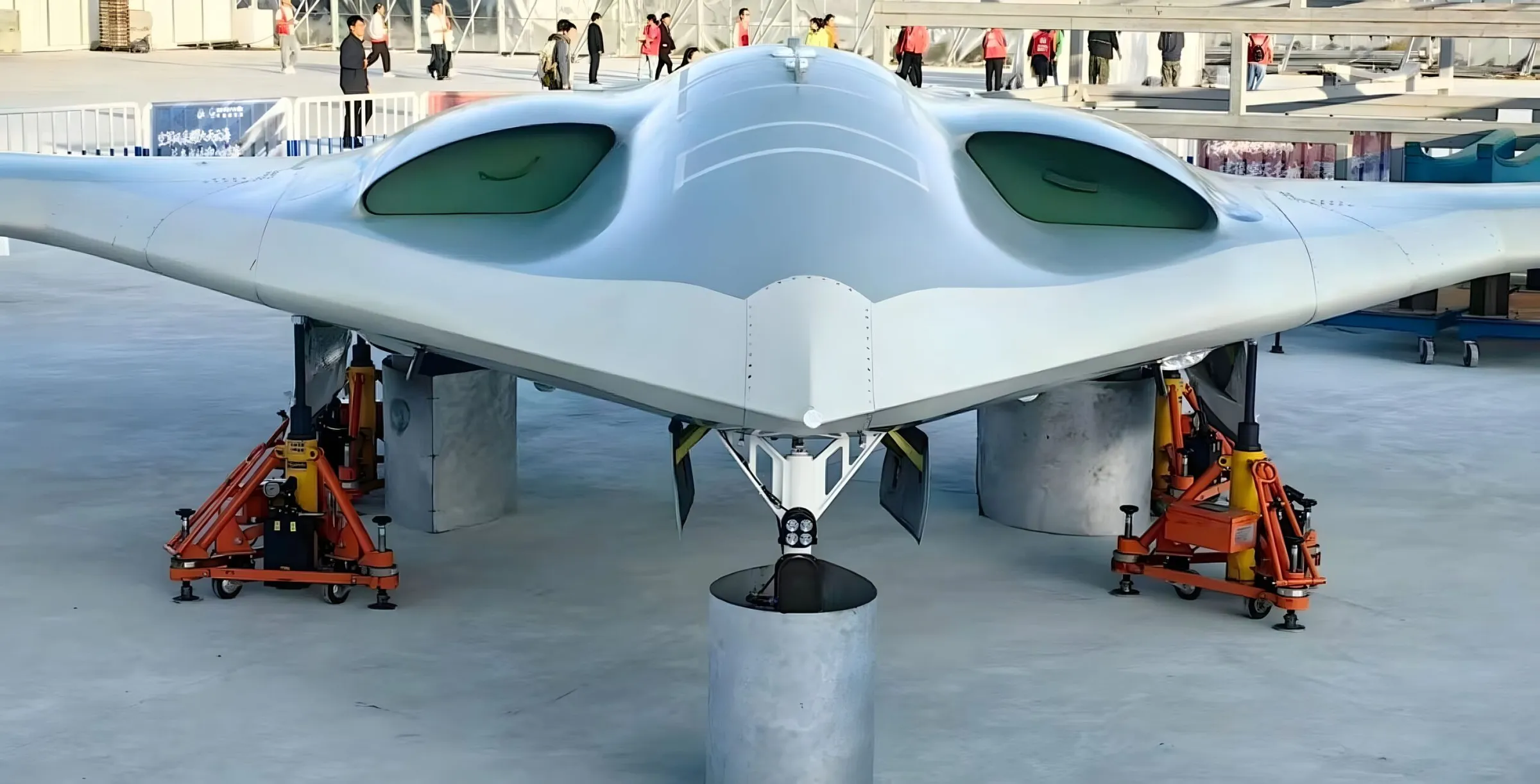
China keeps raising the stakes in large military drones. Only at the start of the month, Beijing showed five new large drones at the parade marking the 80th anniversary of victory, and four of these types had been completely unknown until then. In the West they were classified as “loyal wingman” or “collaborative drones”; Chinese commentators, by contrast, speak of “unmanned combat aerial vehicles” (UCAVs). All share a stealthy shape designed for low observability and weapons carried internally.
Less than three weeks later, the next new model has appeared, this time around the Changchun Air Show, which ended on 23 September. The drone is designated KZ-2, and the Chinese Academy of Sciences (CAS) was shown as the manufacturer. The logo also revealed the “Institute of Engineering Thermophysics”.


With more than 70,000 employees, CAS is considered the world's largest research organisation; it runs almost 100 institutes across all STEM disciplines. Formally, it is a civilian institution. However, because it is closely intertwined with the People's Liberation Army, projects with military applications repeatedly emerge there.
Cranked edge and two air intakes
A characteristic feature of the KZ-2 is a cranked line on the wing leading edge. Two air intakes are set into it, feeding the top-mounted engines. The GJ-11/-21 shown at the parade, by contrast, each have only one engine – the chosen arrangement could therefore point to a design for supersonic flight. Below the fuselage there is also likely to be room for an internal weapons bay.
Notably, many details argue against a mere mock-up. Visible control surfaces, surface details and position lights in the flying-wing sections suggest a flightworthy system – or at least that the first flight is imminent.
Test bed for military drones or weapon system?
On the other hand, the prototype still shows a number of makeshift solutions: bolts, protruding parts, adhesive tape. This is common for development models where function comes first. Experts therefore believe CAS wants to use the KZ-2 to test whether a twin-engine stealth drone is feasible. Weapons integration trials would also be possible, for example for dropping precision munitions or smaller kamikaze drones.

The platform could equally serve as a technology demonstrator to validate key technologies for future systems. These include new stealth materials, engines, navigation and communication systems – including approaches to quantum communication and quantum navigation – and advanced avionics. Nor can it be ruled out that the drone is linked to the H-20, the stealth bomber China is currently developing as a counterpart to the American B-21.
Two engines for the first time
Among unmanned stealth drones, the KZ-2 with its two engines breaks new ground in any case. Compared with Western types such as nEUROn, Taranis, Kizilelma or X-47B, it appears larger. There is no official information on its intended role so far; further details may only come to light through observations by visitors in Changchun. What is clear, however, is that China is once again putting itself at the forefront of global drone development.
Photo credits
© Weibo
Continue exploring

Loitering munition Virtus from Stark: 45th Armoured Brigade “Litauen” tests it at “Freedom Shield 2026”

Drone stations for maritime surveillance: Rift begins tests off the French coast

Sea drones for the Baltic: Sweden buys surveillance from Saildrone as a service

Maritime drones: Eviden unveils SMX, an electromagnetic navigation sensor
