





Counter-UAS at Saab: from Giraffe 1X to Nimbrix, Loke and RBS 70 NG
Cheap drones, expensive defences: Giraffe 1X, the Nimbrix missile and the Loke concept, realised in 84 days, show how Saab wants to make counter-UAS affordable. According to Per Järbur, there is no perfect system.

What was once considered a marginal phenomenon is now a serious danger for armed forces: unmanned aerial vehicles (UAV) have become a central threat in recent years – and counter-UAS has moved into focus as a result. This is most evident in the war in Ukraine. There, cheap drones effectively strike a wide range of targets, from infrastructure and mechanised formations to individual soldiers. Affordable countermeasures are hard to find, but not impossible. A closer look shows how Swedish defence group Saab is tackling the problem.
Sensor, command, effector: the structure of ground-based air defence
Three components form the core of a ground-based air defence system (Ground Based Air Defence, GBAD):
- sensors, which act as the eyes of the operation,
- command and control (C2) in a command and control centre that works as the brain,
- effectors, the muscles, so to speak, with which a threat is defeated.
Modern sensors – such as Saab's Giraffe 1X radar system – can already precisely detect and classify even the smallest targets. Depending on target type, distance and environmental conditions, objects with a radar cross-section below 0.01 square metres are detected. With this high sensitivity, however, the volume of data keeps growing.
This data can nevertheless be processed in fractions of a second, thanks to the computing power of modern C2 systems, which will in future be supported by artificial intelligence. The resulting high level of situational awareness allows rapid decisions and the best possible choice of effector.
Two ways to take out a drone
Air defence basically knows two approaches: soft kill (electronic defence) and hard kill (physical destruction). In drone attacks, this distinction matters particularly, because UAVs serve both for reconnaissance and as precision weapons.
Per Järbur, air defence expert at Saab, frames the starting questions as follows: “When we talk about counter-unmanned aircraft systems (C-UAS), we must first clarify whether we mean systems to protect civilian infrastructure in peacetime – or those meant to fight swarms of drones at the front. Are we talking about military MOTS solutions or commercial COTS products – and how do their costs differ?”
Possible countermeasures include electronic warfare and cyber defence as well as kinetic weapon systems. A central difficulty remains the cost ratio: a drone costs only a few hundred euros, whereas modern defence systems can cost millions – and are often available only after long production times.
Nimbrix: a small missile at low cost
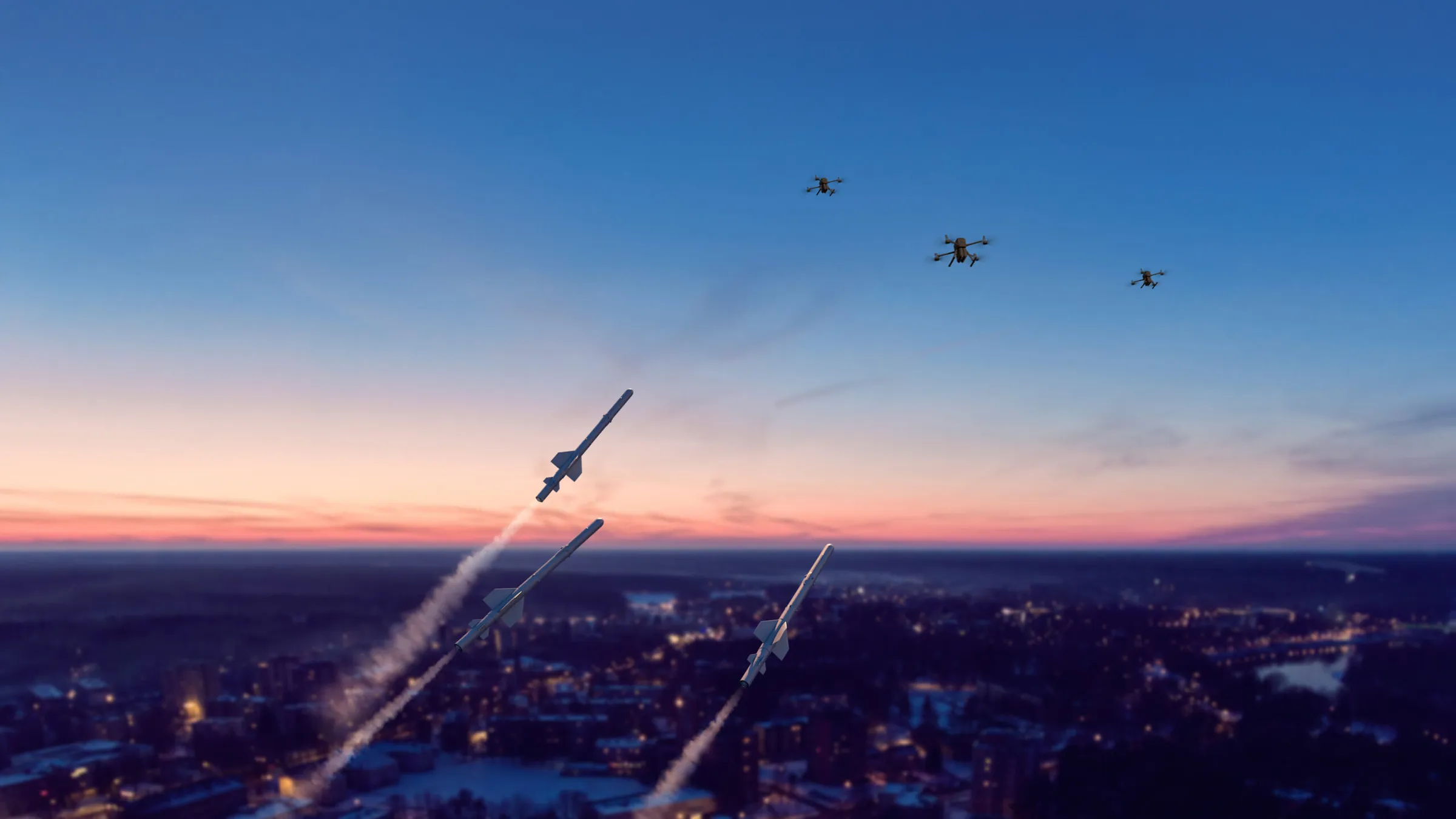
Saab recently presented a possible way out with Nimbrix. The fire-and-forget missile is being developed with a seeker, hard-kill warhead and small footprint, at comparatively low cost. Weighing less than three kilograms, it is to engage targets up to five kilometres away. In air-burst mode, the charge can neutralise entire swarms. First units are to be delivered in 2026; Nimbrix can be used on its own or integrated into larger air defence systems.
Counter-UAS in 84 days: the Loke concept
In Ukraine, the employment patterns of attack and reconnaissance drones change every three to four months. Defence technology must keep pace just as quickly. How fast this can happen is shown by a remarkable collaboration between the Swedish Air Force, procurement agency FMV and Saab: within just 84 days, the Loke concept was created, a mobile and modular system for combat troops.
It brings together the Giraffe 1X radar, a lightweight C2 solution based on the SHORAD principle and effectors, including a small-calibre cannon on the Trackfire Remote Weapon Station. The system can be installed on land as well as at sea, for example on the Combat Boat 90.
Järbur describes the approach as follows: “With Loke, we deliberately did not pursue a development cycle lasting years, but repurposed existing systems and integrated new technologies. This allowed us to react in record time”. Loke is scalable and adaptable, and it remains operational even on the move.

No single solution
For hard kill, Saab also offers the RBS 70 NG. The missile reaches a range of 9,000 metres and an altitude of 5,000 metres and cannot be jammed. At the same time, the company sees great potential in soft-kill solutions such as jammers, nets or hunter drones. According to the Swedish defence manufacturer, new concepts are being researched together with start-ups and industry.
“There is no golden solution, no perfect C-UAS system that defeats all threats – neither today nor tomorrow”, Järbur stresses. Armed forces must analyse each threat situation precisely and rely on a combination of several systems. Equally indispensable is joint NATO air defence, which so far, however, remains a distant prospect.
The technology exists – speed is what counts
What is clear is that there is no way around counter-drone (C-UAS) systems in the coming years. Cooperation and interoperability across NATO would be a decisive advantage. Even more important than the technology, however, is finding the right balance in “cost per kill”: the growing threat must also be countered permanently with guided – and quickly reproducible – means.
Photo credits
© Saab
Continue exploring

Loitering munition Virtus from Stark: 45th Armoured Brigade “Litauen” tests it at “Freedom Shield 2026”

Drone stations for maritime surveillance: Rift begins tests off the French coast

Sea drones for the Baltic: Sweden buys surveillance from Saildrone as a service

Maritime drones: Eviden unveils SMX, an electromagnetic navigation sensor
