





AI fighter jet X-BAT: Shield AI unveils autonomous vertical take-off aircraft with Hivemind pilot
In Washington D.C., Shield AI has shown a mock-up of the X-BAT – an autonomous AI fighter jet that takes off and lands vertically. It is to be operational from 2027/28. What lies behind the concept and which questions remain open.
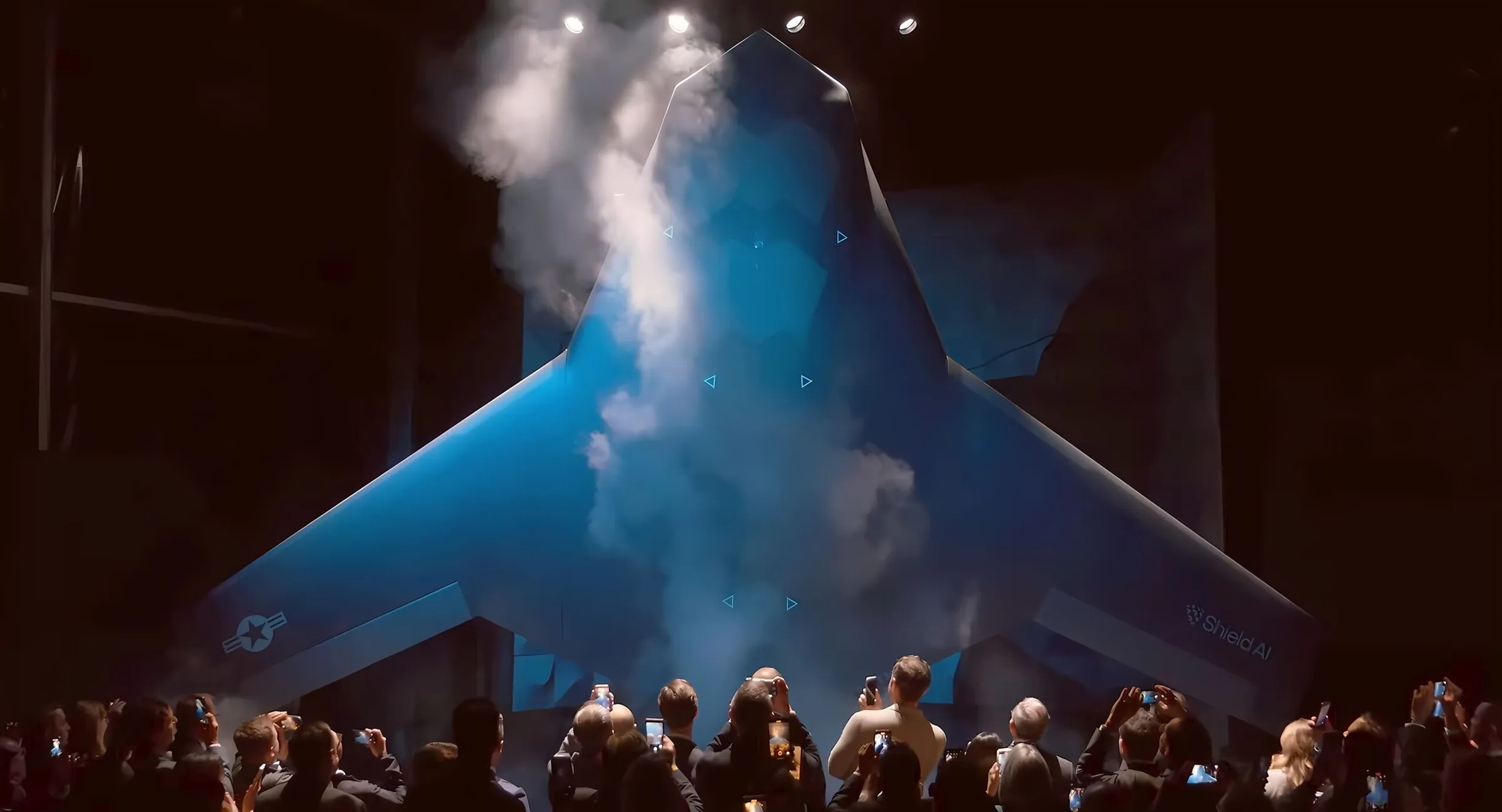
It is not meant to be a “collaborative wingman”, nor an “expendable” unmanned combat aerial vehicle (UCAV): with the X-BAT, US company Shield AI wants to open an entirely new chapter in air combat technology. Presented a few days ago in Washington D.C., it is a fully autonomous combat aircraft for vertical take-off and landing (VTOL), flown by artificial intelligence (AI) – an AI fighter jet.
Only a two-thirds-scale mock-up of the planned final product was shown. Yet the goals are ambitious: as a fully fledged unmanned VTOL fighter jet, the X-BAT is to be operational from 2027/28, designed for heavily contested airspace where runways are absent or destroyed.
Built for expeditionary operations
Planned are a range of more than 2,000 nautical miles (around 3,700 kilometres) and operating altitudes above 50,000 feet (just over 15,000 metres). An F100 engine with afterburner is to take the jet to near-supersonic speed; the manufacturer, however, prioritises range and endurance.
Towards the US Armed Forces, Shield AI is positioning the X-BAT as an ideal platform for expeditionary operations, maritime operations and island bases. The focus is clear: the Western Pacific and a possible conflict scenario with China.
The company behind the X-BAT
Shield AI was founded in San Diego in 2015 and is among the most dynamic start-ups in the US defence and aerospace industry. It was founded by the brothers Brandon and Baron Tseng – the latter now its CEO – and Andrew Reiter, who rely on the principle of “agile innovation”, familiar from tech pioneers such as Elon Musk (Space X) or Palmer Luckey (Anduril): young, unconventional and fast. Shield AI deliberately sees itself as a counter-model to the large, slow-moving US defence groups.
Staff also link it to this new generation of high-tech firms. Armor Harris, lead chief engineer of the X-BAT, comes from Space X, bringing experience in propulsion and systems integration.

Shield AI already has a mature product in its portfolio: the V-BAT, a vertical take-off system for reconnaissance and surveillance that has already proven itself in operational use, including in Ukraine.
The core of the technology, however, is Hivemind, the company’s AI “pilot”. The software platform enables autonomous navigation and decision-making, works even without GPS or a data link and can control several systems simultaneously. This enables complex, coordinated missions – Shield AI’s decisive technological lead over many competitors.
Four arguments for the AI fighter jet
In Washington, Armor Harris presented the basic idea behind the X-BAT vertical take-off combat aircraft and summed up its advantages in four clear points. His core message: nothing less than a revolution in air combat power – own forces gain flexibility, the adversary faces new problems.

The four key advantages at a glance:
- VTOL: the X-BAT can operate from warships, islands, ports and improvised surfaces – precisely where conventional airfields are lacking or have been destroyed.
- Multi-role capability: instead of specialised individual vehicles, the concept provides one platform for different mission profiles (reconnaissance, combat, operations at sea).
- Architecture for AI pilots: the aircraft is designed from the ground up for autonomous missions with an AI pilot such as Hivemind – as an integrated system, not merely a retrofit.
- Significantly lower life-cycle costs: according to Shield AI, costs over the entire life cycle are to be up to ten times lower than those of fifth-generation aircraft – a central selling point at a time of tight budgets.
Vulnerability on the ground
Harris draws attention to a practical problem facing today’s air forces: in current war scenarios, far more aircraft are destroyed on the ground than in air combat. Recent conflicts show that ground-based attacks and low-cost drone strategies can knock out capable, expensive air forces. Decades of investment in expensive stealth platforms raise survivability in the air – on the ground the aircraft remain just as vulnerable.

Bunkers, tankers or new platforms
Harris names expensive bunkers, longer tanker chains or even larger and more expensive aircraft as the classic countermeasures. This creates a strategic dilemma: either expensive assets are protected with equally expensive means, or the platforms themselves are rethought. The X-BAT is Shield AI’s answer for the latter – decentralised, enduring, autonomous and cheaper on the budget.
Only field tests and operational use will show whether the theory holds up in practice. What is real, however, is the shift in the debate towards autonomous, VTOL-capable platforms – and it raises new tactical and ethical questions for planners.
Escaping the cost trap through expeditionary operations
For Shield AI, expeditionary vertical take-off and landing is the key to breaking free from the strategic shackles and rising cost curve of modern air warfare. A VTOL concept does not rely on large, central bases but distributes air power close to the area of operations. Closer to the front lines, it becomes harder for the adversary to predict and to attack.
The X-BAT was deliberately designed to be mobile on the road as well as capable of vertical take-off and landing. This allows landing, relocation and renewed take-off in quick succession. Movement means protection: acting within the adversary’s targeting and reaction window considerably improves survival chances on the ground.

Harris adds: because many missions can start directly from the combat zone, the X-BAT is less dependent on tanker aircraft. In many scenarios, expensive fixed shelters also become superfluous – instead of concrete, the platform protects itself through relocation and dispersion.
Striking power even without aircraft carriers
At sea, VTOL capability takes pressure off aircraft carriers, whose deck space is scarce and expensive. Aircraft that take off vertically enable power projection from other ship types in a fleet as well: from helicopter carriers and smaller littoral combat ships to – theoretically – cargo or container ships. Harris cites concrete orders of magnitude: dozens of X-BATs would fit on Marine Corps helicopter carriers, enough to exceed the striking power of entire air forces.
Thanks to the long range, the launch ship can remain outside immediate threat zones and does not need an abundance of complex, expensive self-protection systems. Together, mobility, range and autonomous control promise a more flexible, more resilient and more cost-efficient form of air power – provided the technology proves itself in practice.
A different approach to VTOL design
According to chief engineer Armor Harris, the X-BAT relies on radically simplified propulsion. An F-16-class engine with afterburner sits in the centre of the aircraft, combined with a thrust-vectoring nozzle that originally comes from an F-15 test programme of the late 1990s. This eliminates many design weaknesses of earlier VTOL concepts.

On the F-35B, for example, the complex lift-fan system reduces fuel volume and payload and limits operational flexibility. The X-BAT, by contrast, needs no additional lift system. The result is less complexity, greater efficiency and additional space for fuel – and therefore longer range.
Added to this is the tailless design with an optimised lift-to-drag ratio, while the powerful engine in the compact airframe provides high climb performance and extreme flight altitudes. Harris sums it up: “The X-BAT will be one of the highest and fastest aircraft in the sky.” By design, the construction is also stealth-capable and has a low signature – decisive for survival in modern air combat.
At another appearance, Shield AI CEO Baron Tseng, himself a former Navy SEAL, explained to US video blogger Shawn Ryan what distinguishes the concept.
With Hivemind, Shield AI is among the pioneers of AI-controlled aircraft, but the company is by no means alone. In the X-62A VISTA programme, a modified F-16 was already trained with the help of artificial intelligence – still with a backup pilot on board, but already able to fight air battles against crewed opponents.
Comparable technologies are also emerging in Europe. Marcus Wandt, Saab test pilot and ESA astronaut and Senior Vice President at Saab for the past few days, reported on the AI pilot Centaur from the company Helsing, which is being tested in the AI-controlled Gripen. Wandt’s assessment: “In future it will no longer be a given that a human can prevail against an AI in air combat – it learns within a few flight hours what takes humans decades.”
The difference lies in the approach: systems such as Centaur have so far worked cooperatively, whereas Shield AI is consistently pursuing an autonomous operating philosophy with the X-BAT – a step that could fundamentally change air warfare.
It remains open whether the US Armed Forces or their allies will actually take this path. Baron and Brandon Tseng, in any case, are convinced that AI-controlled vertical take-off fighter jets will permanently change thinking about air power and its use.
Photo credits
© Shield AI
Continue exploring

Loitering munition Virtus from Stark: 45th Armoured Brigade “Litauen” tests it at “Freedom Shield 2026”

Drone stations for maritime surveillance: Rift begins tests off the French coast

Sea drones for the Baltic: Sweden buys surveillance from Saildrone as a service

Maritime drones: Eviden unveils SMX, an electromagnetic navigation sensor
