





Unmanned systems at “Repmus 2025”: Schiebel flies Camcopter S-100 in Portuguese Navy NATO exercise
Signals intelligence, AI anomaly detection and control directly from the Tacticos console: at “Repmus 2025”, Schiebel tested its Camcopter S-100 with several payloads. The focus: how unmanned systems can be integrated into modern combat management systems.
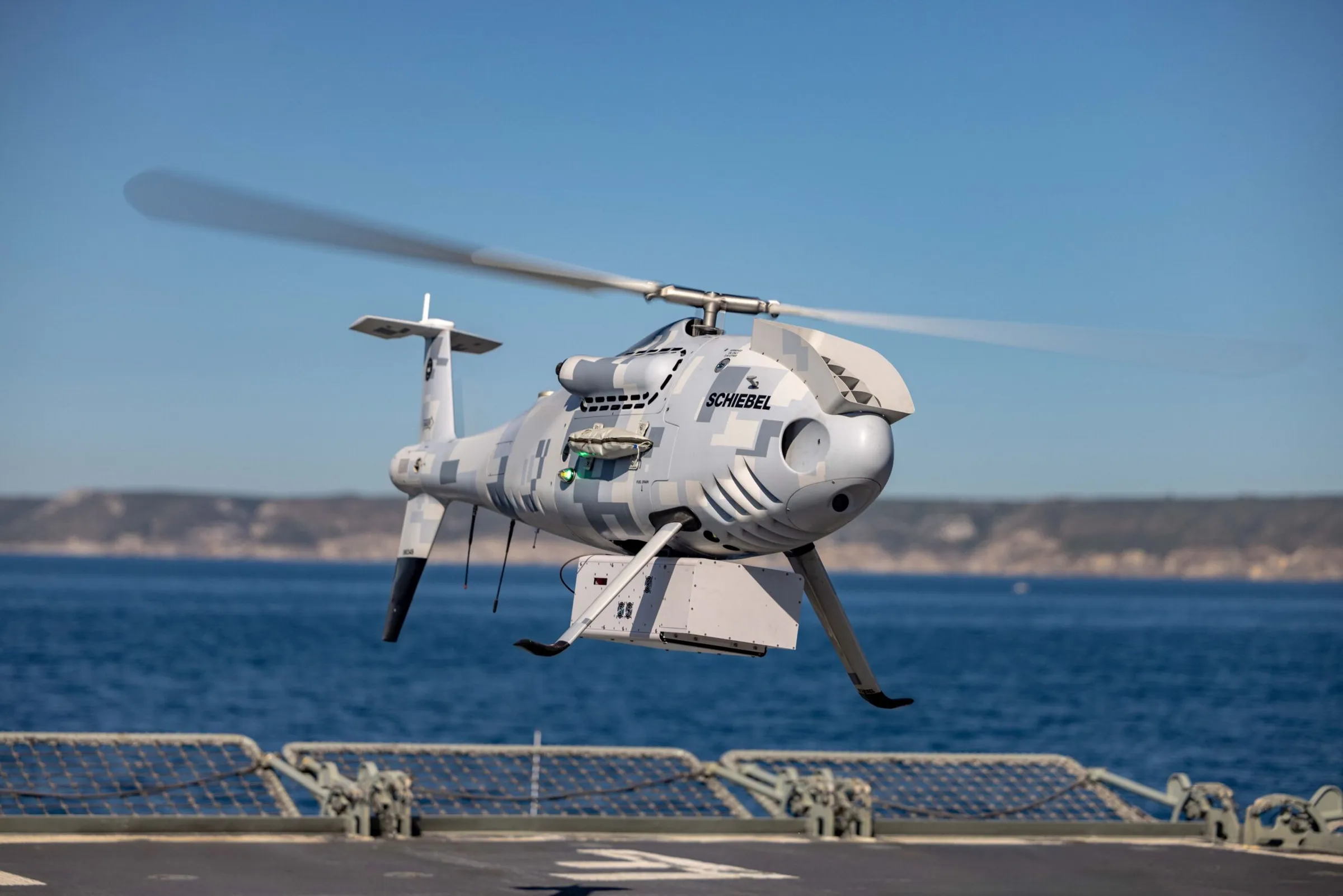
Unmanned systems in maritime operations were the focus of this year's NATO exercise “Repmus 2025” (Robotic Experimentation and Prototyping using Maritime Uncrewed Systems), hosted by the Portuguese Navy. Schiebel was once again present with its Camcopter S-100. In several missions, the unmanned rotary-wing system proved that it is suited to maritime environments and can be integrated into modern combat management systems.
According to the Austrian drone manufacturer, the S-100 carried a range of advanced sensors, communication links and AI-supported data modules. Among other things, the CRFS RFeye Node 100-18 LW was tested: this signals intelligence (SIGINT) sensor detects activity in the frequency range up to 18 GHz and can geolocate it in real time.


In addition, there was the Akheros Skylock system, based on the AI framework of NATO DIANA (Defence Innovation Accelerator for the North Atlantic). It makes it possible to analyse and detect anomalies during flight; procedures for data fusion and autonomous decision support were tested in this way.
Tacticos integration for unmanned systems
The focus was on integration into Tacticos, the combat management system from Thales. The new STANAG 4817 protocol was demonstrated, through which operators were able to control the S-100 directly from the Tacticos console. This is seen as a step towards a standardised, NATO-wide command architecture.
Also shown were the Oceanwatch PT-8 sensor, developed to detect small objects on the sea surface autonomously over long distances, and a bathymetric LiDAR (Areté PILLS/PNGS). In cooperation with the US company Areté, the new LiDAR system for shallow waters and obstacle detection was tested. The technology's sampling rate increased, and it was used successfully on a Portuguese offshore patrol vessel.
Hans Georg Schiebel, Chairman of the Schiebel Group, said: “The ‘Repmus’ exercise offers a realistic environment for testing capabilities in the maritime domain and further developing interoperability between systems and nations”.
Only recently, the Austrian drone manufacturer also presented weapon-capable variants of the S-100 and the larger S-300.
Photo credits
© Schiebel
Continue exploring

Loitering munition Virtus from Stark: 45th Armoured Brigade “Litauen” tests it at “Freedom Shield 2026”

Drone stations for maritime surveillance: Rift begins tests off the French coast

Sea drones for the Baltic: Sweden buys surveillance from Saildrone as a service

Maritime drones: Eviden unveils SMX, an electromagnetic navigation sensor
