





Interceptor drone from Argus Interception: “Intercept drones – or better, capture them”
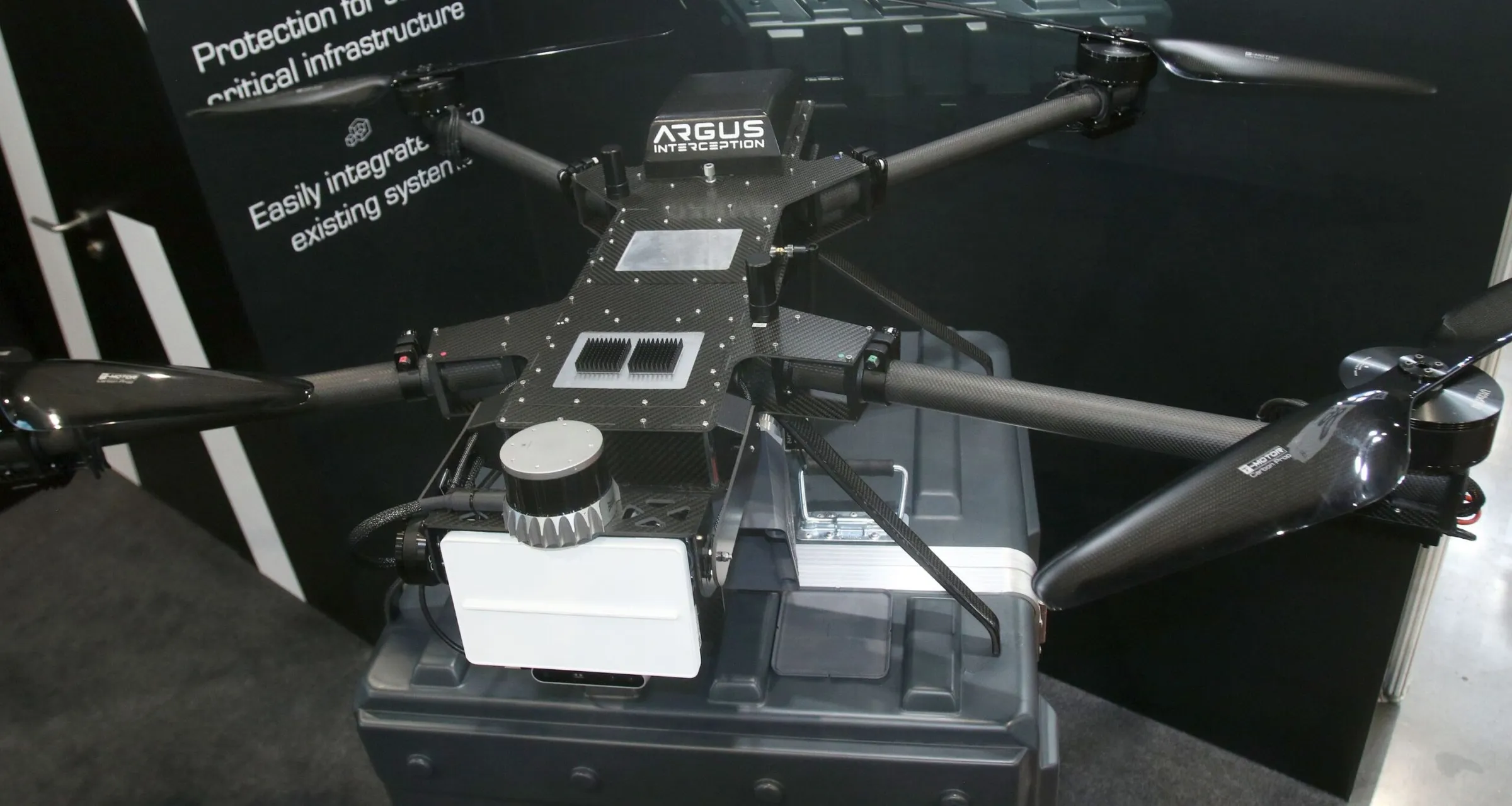
German drone start-up Argus is bringing an interceptor drone to market: a large quadcopter that captures unwanted or hostile drones with launched nets. In an interview, co-founder and CSO Sven Steingräber talks about the concept and the technology.
Translated from the German original interview:Reviewed by the Unmanned Magazine editorial team.
The German drone start-up Argus is bringing an innovative system to market: a large quadcopter interceptor drone that captures unwanted or hostile drones by means of launched nets. With this approach, Argus attracted attention at IDEX in Abu Dhabi and IDET in Brno. In an interview, Argus co-founder and CSO Sven Steingräber talks about the concept and the technology.

Mr Steingräber, how did the idea behind your venture come about?
The idea arose at the Helmut Schmidt University of the Bundeswehr (German Armed Forces) in Hamburg as part of the research project FALKE – which stands for “Fähigkeit des Abfangens von in gesperrte Lufträume eindringenden Kleinfluggeräten durch zivile Einsatzmittel” (capability to intercept small aircraft penetrating restricted airspace using civilian assets). Argus Interception was founded in 2023 by former officers (HSU alumni). Since 2024 we have been based in Rotenburg (Wümme). As former students, we also continue to maintain a strategic partnership with the university. And of course it would be a nice common thread if our product were one day used in the armed forces as well, perhaps even by the Austrian Armed Forces (Bundesheer).
So your product is not yet in use with the authorities in Germany?
Interest in our solution is great. We work closely with police forces, authorities and also the Bundeswehr. We regularly carry out demos to present the system. At first there is often scepticism as to whether the technology is really ready for operational use. But in tests and demonstrations we have been able to show that our system is ready for the market.
What does “well developed” mean in this context – are we talking about success rates in the region of 100 per cent?
It always depends on the operational scenario. Precise figures on the probability of a hit are therefore difficult. Speeds are also important. We started from requirements of around 5 metres per second. In the meantime we have been able to make the system significantly more powerful, so that higher interception speeds are possible.
What does a deployment of your quadcopter look like?
It requires ground-based sensors, which serve to detect the threat from the air. These sensors then guide our interceptor to the target. In the air, our drone looks for itself with its own on-board sensors and verifies the target. The drone can then either follow the target, which serves to observe the drone's flight behaviour or, if necessary, to locate the pilot. In the event of imminent danger, the drone can also receive the immediate command to capture the drone with the net as quickly as possible. The interceptor then proceeds to the target by the fastest route and captures it. Once a drone has been captured, it can be set down automatically at a safe location.


This approach should be of interest to authorities, because the target is not destroyed but secured. Can the control data of the captured targets be read out after the operation?
That is exactly our approach. Because it means there are no falling parts that could land on people or infrastructure. Even more important for state authorities, however, are the questions: What did the drone record? Where did it come from? Who controlled it? All this is possible because the captured drone is not destroyed.
Up to what weight can targets be captured?
We are currently able to capture drones weighing up to several kilograms – in other words almost everything that is commercially available, including modified drones. It makes no difference whether, for example, only one rotor of the target is caught. Because even then the target is incapacitated, i.e. “disabled”, but does not crash.

So your quadcopter captures the target with nets. Has it ever happened that the captured drone “escaped” from the net?
No, once a drone has been captured, it has not happened to date that a drone has got away from us. The 4×4 metre or 7×7 metre net wraps itself around the drone in such a way that escape is impossible.
Does this capture always follow the same pattern?
Not necessarily. There are two different modes: the “dogfight” mode – air combat, as it were – in which we position ourselves behind the target and fire the net. And the “shield” mode: here the interceptor drone positions itself head-on in the target's approach path and captures it with a net released in good time. This requires rapid adjustments – in altitude, position, direction – to maximise the probability of capture.
What part does AI play in this?
Artificial intelligence handles the data fusion – that is, the interaction of radar, LiDAR, optical sensors and the ground control station. At long range the radar works, at close range the LiDAR. The AI continuously calculates the distances and helps determine the optimal attack position – like a small fire-control computer.
The drones used, for example, in the war in Ukraine are relatively cheap to procure. Can your system keep up, or does a police or military unit have to commit clearly to the system?
Counter-drone defence tends always to be more expensive than the drone attack. This is because powerful sensors are needed to detect small systems in the air. Solutions must be found to defend effectively against ever smaller, more powerful and more autonomous drones. This means that different sensors must be networked with one another in order to master this threat.
Photo credits
© Georg Mader · © Argus · © Militär Aktuell
Continue exploring

Loitering munition Virtus from Stark: 45th Armoured Brigade “Litauen” tests it at “Freedom Shield 2026”

Drone stations for maritime surveillance: Rift begins tests off the French coast

Sea drones for the Baltic: Sweden buys surveillance from Saildrone as a service

Maritime drones: Eviden unveils SMX, an electromagnetic navigation sensor
