





Unmanned helicopter at 20: Camcopter and a look into Schiebel's future
For two decades the Camcopter S-100 unmanned helicopter has shaped unmanned aviation. Now the S-300 is waiting in the wings. Hans Georg Schiebel on the evolution of the S-100, the new model's missions and Austria as a location for innovation.
Translated from the German original interview:Reviewed by the Unmanned Magazine editorial team.
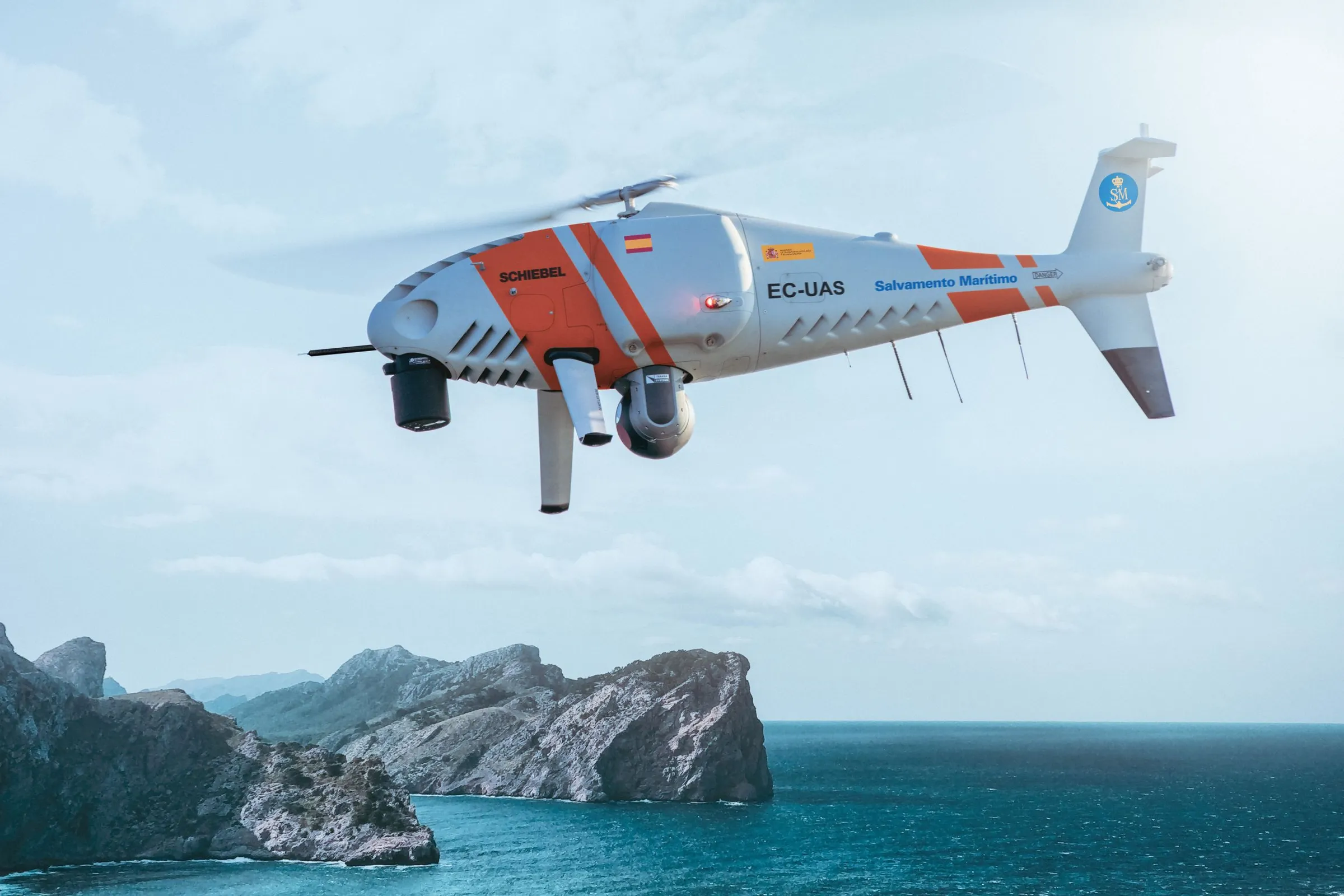
For two decades the Camcopter S-100 unmanned helicopter has shaped unmanned aviation, and today it is in service worldwide. But development does not stand still: with the S-300, a new model is waiting in the wings that is set to be even more capable and versatile.
In this interview, Schiebel chief Hans Georg Schiebel talks about the evolution of the S-100, the challenges of technology development and the future applications of the S-300 – as well as about Austria's role as a location for innovation in a changing security-policy landscape.

Mr Schiebel, 20 years of Camcopter – what stands out most in your memory?
One moment that strongly reminded me of the early days was the first flight of our newly developed Camcopter S-300 this year. It is always impressive when a project into which so much energy, know-how and passion has flowed actually takes off for the first time. That is how it was back then with the S-100, and that is how it is now with the S-300 – perhaps just a touch bigger. (smiles) Over the past 20 years we have grown enormously as a company and now have more than 45 customers on five continents. In Ukraine we had already been operating for the OSCE for ten years before the war began. There we gained valuable experience with jamming technologies – knowledge that is of great use today.
The helicopter is two decades old. What has changed? How old are the oldest units still in operation?
Internally, a dramatic amount has changed in that time. Over the entire production period, almost all components inside the fuselage have been optimised. We continuously invest a great deal of effort in further expanding our technology leadership. Our helicopters can be uniquely identified by their serial numbers – in principle a kind of block designation. The oldest Camcopter I know of that is still flying is 19 years old, and of course we continue to offer support. If a customer wishes, they can send us the log files for analysis. At the same time, we train our customers so that they can carry out early maintenance detection themselves.

The S-100 is mainly used for maritime surveillance. How large are the cost savings compared with a manned system?
The S-100 is used equally at sea and on land. The operating costs of a warship per nautical mile are, as is well known, exorbitant – we need not even start calculating. But even compared with a manned helicopter, the costs of the S-100 are up to fifty times lower. Added to this is the human factor: when a manned helicopter is lost, not only the aircraft is at stake but also the lives of the pilots. Should the worst happen, that is a human tragedy. When a drone is lost, only a machine is lost – it can be replaced.
The new S-300 is coming soon. Will production of the S-100 continue?
Yes, of course. The S-100 is the world market leader in its class. It is particularly convincing in the areas of inspection and reconnaissance. With a maximum payload of 50 kilograms, it already offers numerous applications. The S-300, by contrast, is designed for higher payloads and longer endurance. It can carry up to 250 kilograms, which enables entirely new applications. One example is use in anti-submarine warfare: the S-300 can drop several sonobuoys whose data are transmitted in real time to the operations centre via a relay function. It thus makes a significant contribution to underwater reconnaissance. We place particular emphasis on ensuring that both systems – S-100 and S-300 – can be operated from the same ground control station. This means that a customer with both models can freely decide until a few minutes before the start of the mission which helicopter to launch.

Visually, the S-300 looks like an enlarged S-100. What is new? How far along is the project?
The family resemblance is entirely intentional. Beneath the surface, however, the S-300 is a completely new development with a different propulsion and rotor concept. We are currently testing with a demonstrator, a tubular steel frame containing all the important mechanical components – and the results so far are surprisingly positive. By the end of May we will complete the first helicopter made entirely from composite materials. Currently 30 to 40 employees are working exclusively on the development of the S-300. Our schedule is clear and ambitious, and we are working flat out on its implementation. In June the first test flights with complete carbon-fibre prototypes will begin.
Is there a particular focus during the test flights?
Three major topics are the focus: weight, weight and weight. Every kilo saved means either more payload or more fuel capacity – and in submarine reconnaissance in particular, long mission times are decisive.
The S-100 is now an integral part of naval warfare. Has the threshold to a purely dual-use system thus been crossed?
No, the threshold remains. In Austria we will continue to operate as a dual-use supplier. However, market requirements are currently changing very quickly. Defence budgets in Europe are rising considerably, and it is quite conceivable that, for example, Schiebel France will respond to this with corresponding offers. As we are internationally positioned, we are preparing to make our contribution. However, the development, production and sale of military variants of our systems must take place abroad – not in Austria.
So such products cannot be built in Austria?
Bureaucracy and the legal situation in Austria are very complex. In France the S-100 is approved for both military and civilian use – but not in Austria. Admittedly, we have excellently trained specialists here and have received good support in many areas over the years. At the same time, test areas for development flights are becoming increasingly difficult to obtain. This slows innovation considerably and is a challenge we face every day. Our industry is developing very rapidly, and to remain internationally competitive we must always be one step ahead of the competition.

How long does it take for a new customer to receive their Camcopter from Austria?
The production time is three to six months. In the meantime, training for flight and maintenance personnel can already begin, which is completed within eight weeks. We are optimally positioned to deliver quickly. However, some components have long lead times – forged parts, for example, take up to 18 months from order to delivery. Although we do not produce helicopters for stock, we already keep the standardised components from which the systems are assembled in stock. This enables us to respond flexibly and promptly to customer enquiries.
Photo credits
© Schiebel · © Georg Mader
Continue exploring

Loitering munition Virtus from Stark: 45th Armoured Brigade “Litauen” tests it at “Freedom Shield 2026”

Drone stations for maritime surveillance: Rift begins tests off the French coast

Sea drones for the Baltic: Sweden buys surveillance from Saildrone as a service

Maritime drones: Eviden unveils SMX, an electromagnetic navigation sensor
