





Interceptor drone Skyron set to benefit: Quantum Systems flies Apex Recordhunter at 777 km/h
On a military training area in central Germany, the Apex Recordhunter breaks 777 km/h, but the flight in the opposite direction fails. For Quantum Systems, more than a world record is at stake: the know-how is to flow into a faster interceptor drone.
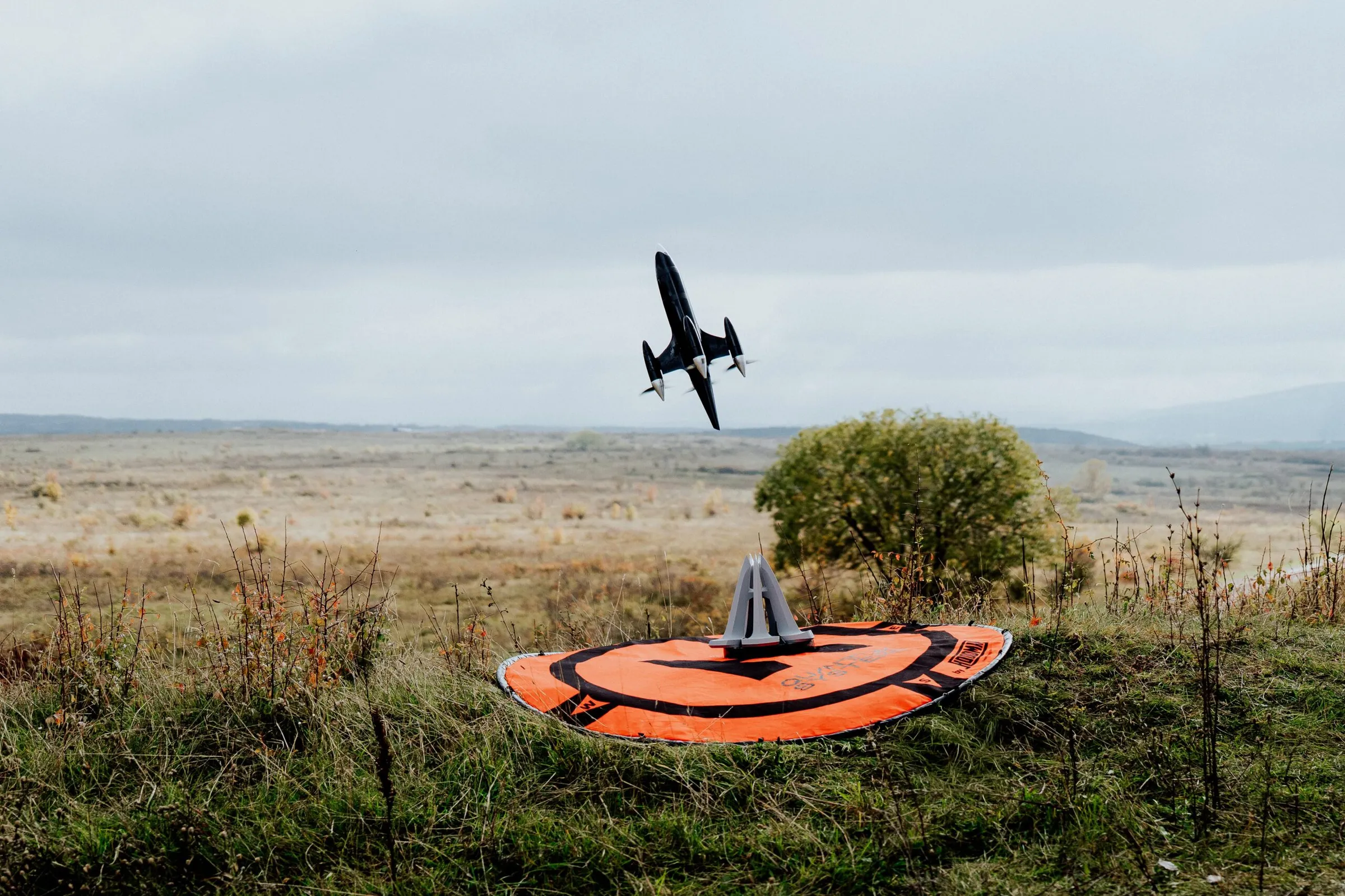
The setting is a military training area in central Germany. There, the German drone manufacturer Quantum Systems intends to set a new world record for battery-electric flight – with an eye on the next generation of interceptor drones, above all the Skyron interceptor drone.
777 km/h, but not yet an official record
The attempt succeeds: Quantum Systems reaches 777 km/h with the Apex Recordhunter aircraft. An officially confirmed world record, however, still requires a successful flight in the opposite direction, as the second run ran into technical problems.

Robert Gardemin, pilot of the Apex Recordhunter and engineer in Quantum Systems’ N3XT innovation unit, says: “We are very proud”. According to him, the previous record stood at 661 km/h. With the new record, the company wants to explore where the limits of a quadcopter design in X-wing configuration lie. It is not just about who flies fastest, but about developing faster interceptor drones.
A response to the jet-powered Geran 5
The background is the situation in Ukraine, where the threat from faster attack drones is growing – for example the jet-powered Geran 5, which reaches up to around 600 km/h. Conventional drones therefore find it increasingly difficult to intercept such targets. Gardemin explains: “This allows us to ensure that we continue to have technology to fly ever faster and with ever higher performance, in order to counter future threats as well”. The results of the record project are primarily intended to benefit the Skyron system family.

During the high-speed flight for the record attempt, the Apex Recordhunter stayed at an altitude of about 50 metres throughout. The world record was verified on site by droneworldrecords.org: the GPS speed data were evaluated and cross-checked against the recordings of the black box on board the drone.
Aerodynamics, electronics, structure, batteries – and the pilot
What makes such speeds possible? Gardemin names airflow first: “Aerodynamics is definitely the dominant force, quite clearly”. The performance cannot be traced back to a single area, however: “Everything comes together through aerodynamics, electronics, structure, batteries. It simply has to work together in perfect harmony.”
Besides the design, the pilot is also put to the test. He has to hit the braking points, bring the speed back down and land the drone safely in the net. According to Gardemin, the system has redundancies in some areas and lacks them in others.

Gardemin gives no public details on battery output, motors or weight. His reasoning: “This is technology that we developed, and of course we now want to keep it for ourselves in future products”. Before the attempt, the team pre-cooled the motors with dry ice while the battery was pre-heated – temperature management contributes to the increase in performance.

From expensive record aircraft to low-cost interceptor drone
Florian Seibel, co-founder and co-CEO of Quantum Systems, was present in person at the world record attempt. Speaking to journalists, he illustrated the difference between the elaborate record aircraft and a cheaper interception solution with an order of magnitude comparable to 50,000 versus 5,000 euros. The demonstrator contains laser-sintered aluminium parts that are polished afterwards. Seibel says: “Every gram counts here. We are dealing with a Formula 1 drone”.

The aim of the development work is nevertheless later mass production at low cost. The know-how is to be transferred so that cheaper and at the same time faster interceptor drones can be built in future. In the cheaper design, injection-moulded plastic parts, for example, will then have to suffice. Seibel adds: “But you could produce 100,000 of those per month”. In the end, what counts is the cost ratio between attack and defence. Seibel puts the cost of a Geran 5 at more than 100,000 euros; he considers defensive means at a tenth of that to be an economically sensible order of magnitude.
New propulsion to make Skyron 200 km/h faster
Seibel sees the next step in installing the propulsion from the record project in the company’s own Skyron interceptor drone. Skyron currently reaches up to 400 km/h; a faster variant with about 600 km/h is under development.

At the same time, the record attempt is a recruitment marketing tool: Seibel hopes to attract engineers to Quantum Systems in this way. “A high-profile attempt shows what technical performance a small company from Munich is capable of delivering. Hopefully that will attract more talent.”
Photo credits
© Quantum Systems · © Stefan Tesch
Continue exploring

Loitering munition Virtus from Stark: 45th Armoured Brigade “Litauen” tests it at “Freedom Shield 2026”

Drone stations for maritime surveillance: Rift begins tests off the French coast

Sea drones for the Baltic: Sweden buys surveillance from Saildrone as a service

Maritime drones: Eviden unveils SMX, an electromagnetic navigation sensor
