





Dronamics: PR director Severina Grozeva Patrone in conversation
Dronamics, the Bulgarian company and world's first airline to build cargo drones, was also the first licensed to fly cargo drones over long distances in the EU. In an interview, Global Communications and PR Director Severina Grozeva Patrone gives an insight.
Translated from the German original interview:Reviewed by the Unmanned Magazine editorial team.
The Bulgarian company Dronamics, the world's first airline to manufacture cargo drones, is among the best-known manufacturers in the industry. Dronamics was also the first company to receive an operating licence for the use of cargo drones over long distances within the European Union. Severina Grozeva Patrone, Global Communications and PR Director at Dronamics, talks about the company's development and the recent expansion of its portfolio into the defence sector.
Dronamics has received official designators from IATA (International Air Transport Association) and ICAO (International Civil Aviation Organization) and is officially recognised alongside the major traditional global airlines. Founded at a time when drones and drone technology had barely moved beyond the stage of conceptual analysis, Dronamics was the first company to introduce a series of new innovations, enabling it to revolutionise logistics and reach a number of technological milestones.

Recently, the Bulgarian company decided to switch from production focused exclusively on the civilian and cargo sector to dual-use production for civilian and military purposes, paving the way for a diversification of production and expansion into the military procurement market.
In which year does the story of Dronamics begin – and who is behind it?
Dronamics was founded in 2014 by the Rangelov brothers – Svilen and Konstantin, an entrepreneur and an aerospace engineer. Both brothers completed their studies abroad and returned to their native Bulgaria to found the company – with the aim of solving a central problem: improving the logistical connectivity of remote and underserved places through long-range drones. Currently, for cost reasons, only about one per cent of goods worldwide are transported by air. Poor infrastructure and even geographical conditions also often pose obstacles.
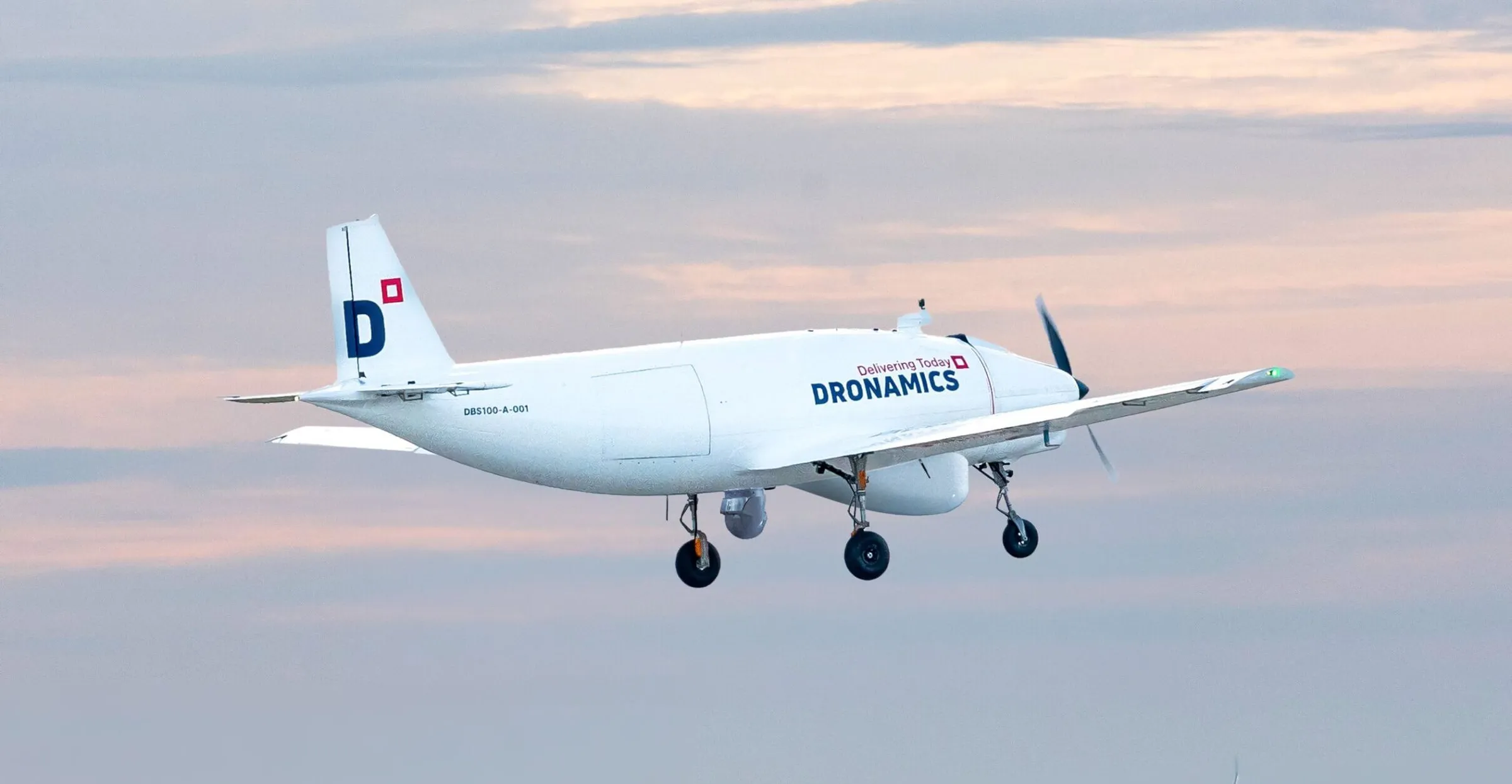
The brothers set out to develop a robust workhorse aircraft that could solve this problem by carrying a meaningful payload (up to 350 kilograms or 3.5 cubic metres, modelled on the capacity of a small delivery van) over a meaningful range (up to 2,500 kilometres, the distance across most of Europe, from Hong Kong to Osaka or from a central location to all 48 contiguous US states). The result is the “Black Swan”, the flagship among the aircraft. Developed as a “delivery van of the skies”, the Black Swan is an example of a pragmatic, clean-sheet aerospace programme developed entirely in Europe. It is currently the only EU-built strategic medium-altitude, long-endurance (MALE) drone that can be used for logistics, defence and disaster-relief missions.
According to public information, from its founding until this year the company concentrated on producing drones for civilian use. What role did this drone market – including in Bulgaria – play in the company's first years of operation?
When we founded the company, the drone market was focused on quadcopter drones for the delivery of individual parcels, while the advanced air mobility market was betting on electric rotorcraft for passengers, also known as air taxis. Despite these trends, we had a clear vision: a next-generation unmanned aircraft system (UAS) had to solve the central challenges of range, payload and cost. The early design decisions were based on achieving this “holy trinity”. The original focus on the civilian logistics sector meant designing and optimising for the most cost-conscious customer – cargo. This led to pragmatic decisions such as optimising range through a fixed-wing and aerodynamic design, resulting in low fuel consumption, as well as the use of a well-known aircraft engine that enables maintenance almost anywhere and allows landing on short runways in order to make use of existing infrastructure.

This sharp focus on payload, range and cost efficiency resulted in an aircraft that can significantly improve operations and outcomes in a wide variety of other missions. As far as civilian applications are concerned, alongside our partnerships in the logistics sector we also work with companies that are world leaders in aerial surveying and natural resource exploration.
This year, Dronamics then decided to expand its production range to the defence sector. Did you already have such a realignment in mind when the company was founded, or what prompted you to take this step?
Our company is shaped by our founders' childhood in the Bulgaria of the 1990s, when shipping had become an additional burden for the population – procuring almost anything took longer and cost more. It is similar with defence: here, too, geography plays a role. Being on Europe's eastern flank means thinking differently about defence. The signals from the European Union that it is prepared to take more responsibility for its own security and defence have increased dramatically, as has the drive for sovereign technology that cannot be switched off at will by a country overseas. We play a role in this. Our Black Swan is the only operational MALE UAS manufactured entirely in Europe that can carry out logistics, disaster-relief and defence missions with the same aircraft.
Our “Black Cygnet”, a remotely piloted aircraft about a quarter the size of the Black Swan, is also suited to defence and public safety tasks, such as wildfire surveillance and early warning, border patrols and search and rescue operations. The concept of the European drone wall, together with various other initiatives aimed at accelerating innovation by promoting dual-use technology, has shown how crucial aerospace sovereignty is for European security.

You have already mentioned the Black Swan several times. How does the variant for the defence sector differ from the civilian version?
“Detect & Defend” builds on the proven Black Swan platform, which is designed for heavy payloads. This means building on an existing, proven and use-agnostic architecture, with only minimal adaptations required to integrate modular systems – sensors and radars. The Black Swan is therefore able to carry out a range of missions: logistics in contested areas, AEW (airborne early warning), ISTAR (intelligence, surveillance, target acquisition and reconnaissance), counter-UAS, mapping, and search and rescue operations.
Our first AEW solution is being developed together with sensor market leader Hensoldt. We jointly presented the “Detect & Defend Black Swan” last June at the international defence and security exhibition “Hemus” in Bulgaria. It integrates Hensoldt's ARGOS-15 sensor and its airborne synthetic aperture radar (SAR) “PrecISR 1400”, enabling a broad spectrum of AEW missions. Demonstrations will follow in the coming months.
Are you considering cooperation partnerships with companies in Ukraine or Romania to expand and further develop new systems and platforms?
We are already working to contribute to the further development of European security and defence capabilities. With a versatile platform and technology that can be adapted to real operational requirements, we are well positioned to meet new requirements in this sector.
Photo credits
© Dronamics · © defencefinancemonitor.com
Continue exploring

Loitering munition Virtus from Stark: 45th Armoured Brigade “Litauen” tests it at “Freedom Shield 2026”

Drone stations for maritime surveillance: Rift begins tests off the French coast

Sea drones for the Baltic: Sweden buys surveillance from Saildrone as a service

Maritime drones: Eviden unveils SMX, an electromagnetic navigation sensor
