





Drone industry: Leonardo and Baykar to manufacture in Italy through LBA Systems
The TB2, TB3, Akinci and Kizilelma are to be built at three Italian sites. What the LBA Systems joint venture plans for the drone industry in Europe – and why certification for civil airspace remains the biggest hurdle.
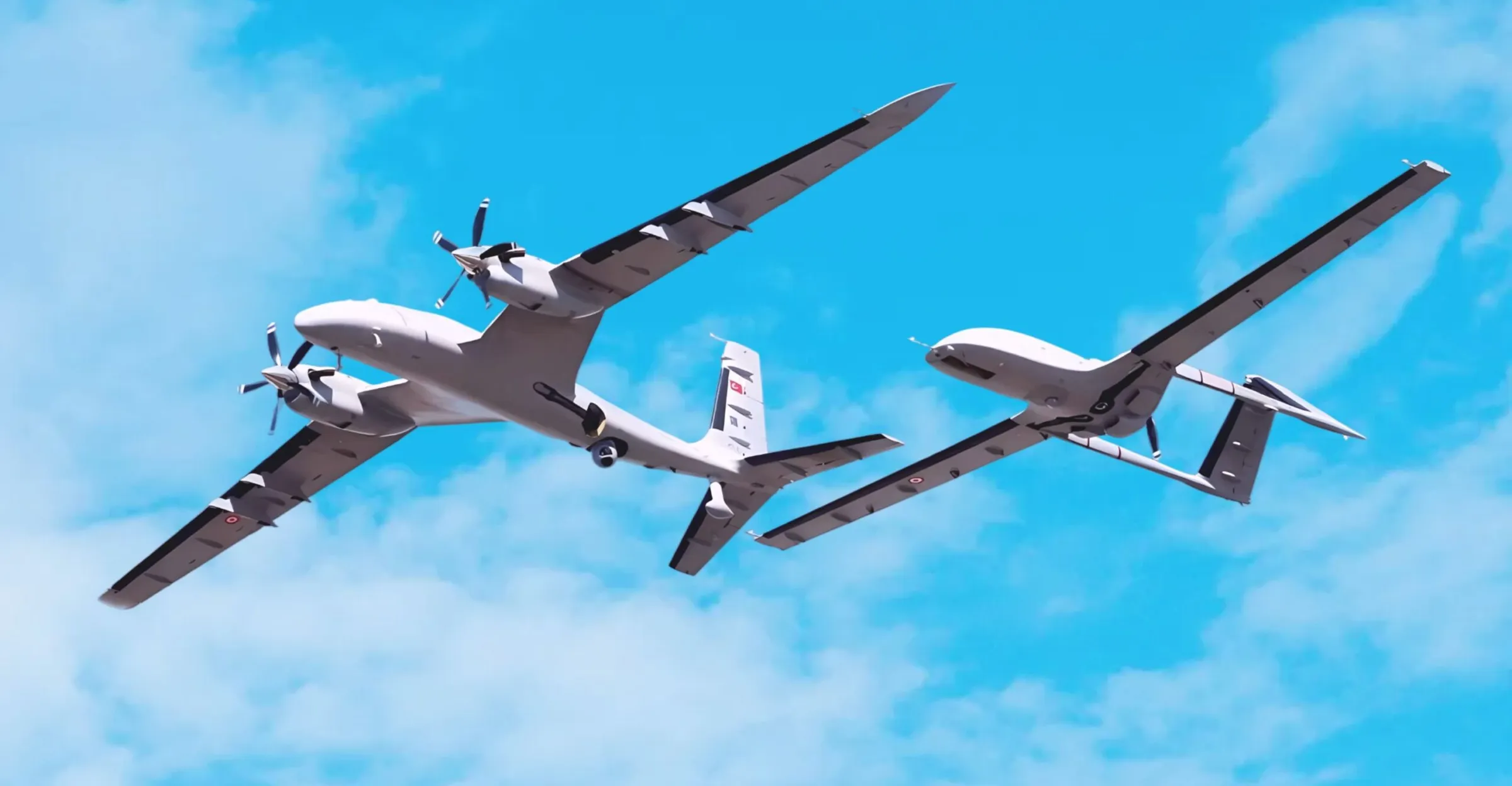
A joint venture for the drone industry: on 6 March, the Italian aerospace group Leonardo and Baykar Technologies signed the founding of the joint venture “LBA Systems”; it was made public only a few days ago. The new company is to develop and produce next-generation unmanned aircraft systems (UAS). The range extends from small unmanned aerial vehicles (UAV) to large medium-altitude, long-endurance (MALE) systems and complementary models.
LBA Systems is headquartered in Italy, with both partners holding equal shares. On one side are Baykar’s platforms, on the other Leonardo’s extensive experience with European certification, payloads and integrated systems. The cooperation covers the entire UAS life cycle – design, development, production and maintenance.
The joint venture’s first project was a version of the successful Akinci: a twin-engine MALE drone that is now in service in eleven countries and here receives Italian sensors and systems from Leonardo. This “Italianised” Akinci was unveiled on 16 June, together with a new TB3 variant that also carries Italian systems. Both share the same new components: the LEOSS-T targeting system, the BRITE STORM jammer, either the Osprey-55/30 or the Gabbiano-T-80UL radar, the Ulisses ASW system, a new transponder, a radio and further subsystems.
Leonardo recently gave further details on the TB3: the drone is to be certified in Italy by 2026. Production will initially take place in Ronchi dei Legionari, Italy’s largest drone manufacturing facility. According to reports, the Italian Navy is also launching a test campaign with the TB3 on the carriers “Cavour” and “Trieste” to prepare for later service with the fleet. The drone can, of course, still be operated from land.
The complete Baykar range from Italian plants
In November, Leonardo CEO Roberto Cingolani explained in more detail how the Baykar drones TB2, TB3, Akinci and Kizilelma are to be built at three sites under the LBA joint venture. Once all regulatory procedures are complete, production will begin of Baykar’s UAV platforms as well as Leonardo’s high-speed Mirach UAV. According to Cingolani, the joint production will rest on three facilities:
- In southern Italy, the unmanned combat aircraft Kizilelma will be built at Leonardo’s Grottaglie plant. The facility currently manufactures composite fuselage sections for the Boeing 787.
- According to Cingolani, Leonardo intends to develop the Kizilelma into a universal fighter that can connect with any crewed or unmanned system, provided the control interfaces are in place.
- The Bayraktar TB3 – a STOL-capable MALE drone that has already flown missions from the Turkish amphibious carrier “TCG Anadolu” (L400) and tested several types of munitions – will come from Leonardo’s Ronchi dei Legionari plant in northern Italy.

Two years of flight operations for the TB3
Baykar Technologies, now an internationally known drone specialist, first showed the Bayraktar TB3 on 27 April 2023 at Teknofest 2023 in Turkey – a new medium-sized MALE drone designed for operation from carriers. A high payload, folding wings and long endurance are intended to cover a wide range of tasks, including airborne early warning (AEW), AWACS, strike, reconnaissance and SIGINT. The system was also presented with a new Turkish-developed engine, the TEI-PD170. The aim is to reduce dependence on foreign engines, especially those from Ukraine. Engine and taxi tests were followed by the maiden flight of the first TB3 prototype on 20 October 2023.

For the TB3, LBA Systems proposes, among other things, integrating the ULISSES acoustic processor. Using multistatic measurement methods, the platform could then detect underwater targets.
TB2 and Akinci to come from Piaggio Aerospace
Piaggio Aerospace will in future build the Bayraktar TB2 and the Akinci. The long-established company had been acquired by Baykar shortly before the LBA Systems joint venture was announced. Piaggio Aerospace will also continue to manufacture the Avanti, a fast turboprop pusher that can be used as a commuter aircraft as well as an MPA platform or for intelligence, surveillance and reconnaissance (ISR).
Leonardo had already shown which payloads and onboard systems could be fitted to the Baykar platforms. The guiding theme: “Baykar’s platforms, Leonardo’s systems”. The goal is attractive solutions that can be certified for the European market and other regions. Named systems include the LEOSS-T electro-optical/infrared (EO/IR) system, the compact BriteStorm electronic warfare (EW) system, the Skyward IRST, AESA radars of the Osprey family and various navigation systems. In Poland, the Osprey 30 is already flying on board the TB2.
Drone industry faces the hurdle of civil airspace
The TB3, especially in its “Italianised” version, would probably also be of interest for the MALE procurement project that the Austrian Armed Forces (Bundesheer) are planning from around 2028. What remains open is how to solve the highly complex, strictly regulated issue of operating in non-segregated civil airspace. The platform must pose no risk whatsoever to civil aircraft. It must detect other traffic itself (“Sense & Avoid”), and it must not continue flying uncontrolled in the event of technical failure or hostile interference.
This requires international airworthiness regulations and NATO STANAG certification – in this cooperation model primarily a task for Leonardo. The Italians bring relevant experience: more than ten years ago, Alenia gained extensive and successful practical experience in sense-&-avoid research with the SKY-Y and SKY-X demonstrators in the EDA’s multinational MIDCAS programme (13 partner companies from five countries).

Officials in the Bundesheer recently voiced scepticism: “Yes, yes, ‘Sense & Avoid’ – I’ve been hearing that for 20 years, but it’s still not fit for everyday use”. The campaigns of the time did prove that different sensor fusion approaches and autonomous avoidance logic are practicable. In tests they worked reliably, up to controlled approaches to a C-27 Spartan at around 150 metres.

However, they never went beyond a “proof of concept” for future regulations. Two decisive elements are still missing for regular operation in civil airspace. One is the formal certification and standardisation of such systems under civil air traffic rules; the other is operational and regulatory integration, including ATC integration, liability issues and emergency procedures. So far, integration has therefore only taken place in controlled corridors, often with additional restrictions that significantly curtail the actual military purpose of the mission.
Switzerland as a “cautionary” example
Switzerland bought six Hermes 900 HFE drones from Israeli manufacturer Elbit Systems in 2015 under the ADS-15 project, for the equivalent of more than 260 million euros. The country has still not reached the entry into service planned for 2019. Above all, the systems do not meet Swiss safety requirements for sense and avoid. They are therefore still not allowed to fly regularly in undivided civil airspace with gliders, paragliders and powered aircraft. Costs have since risen to around 320 million euros. The Swiss Federal Audit Office was highly critical: ten years after the order, the drones were “not operational”. Defence Minister Martin Pfister is currently having the project reviewed once again, and Swiss media consider cancellation entirely possible.
Photo credits
© Baykar · © LBA Systems · © Alenia
Continue exploring

Loitering munition Virtus from Stark: 45th Armoured Brigade “Litauen” tests it at “Freedom Shield 2026”

Drone stations for maritime surveillance: Rift begins tests off the French coast

Sea drones for the Baltic: Sweden buys surveillance from Saildrone as a service

Maritime drones: Eviden unveils SMX, an electromagnetic navigation sensor
