





Drone technology: Sikorsky tests “rotor blown wing” prototype in helicopter and aeroplane mode
52 kilograms, two propellers, more than 40 take-offs and landings: Sikorsky has successfully tested new drone technology, a rotor blown wing prototype. The company sees potential for larger models with hybrid-electric propulsion.
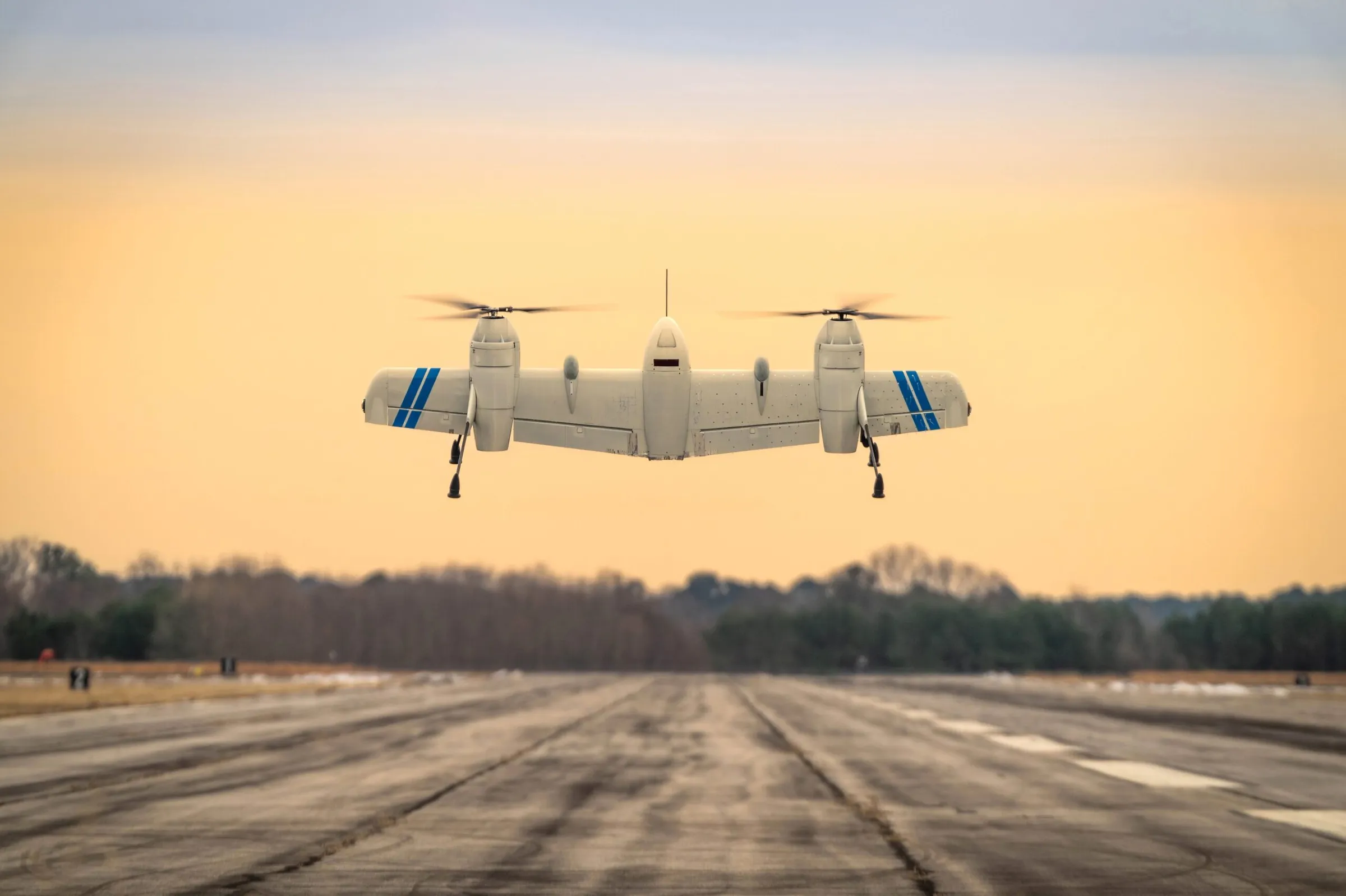
Sikorsky has successfully tested an unmanned aircraft system (UAS) based on drone technology using the “rotor blown wing” principle – in both aeroplane and helicopter mode. According to a recent press release, the 52-kilogram prototype with its two propellers delivered “stable flight performance in all phases of flight” and showed “promising potential for larger models with hybrid-electric propulsion”.
Rich Benton, Vice President and General Manager of Sikorsky, said: “Our rotor blown wing technology combines the best characteristics of helicopters and aeroplanes and enables us to develop faster, longer-range VTOL UAS”. He added: “This design is an example of how we use our long-standing aviation experience to create innovative solutions for the future.”
From simulation to flight test in under a year
Sikorsky Innovations, the company’s development group, completed preliminary design, simulation and real flight tests in less than a year. Sikorsky achieved a decisive success in January 2025 with the 3.14-metre prototype: it completed more than 40 take-offs and landings as well as 30 transitions between helicopter and aeroplane mode. In horizontal flight, the prototype reached up to 86 knots (around 160 km/h).
Igor Cherepinsky, Director of Sikorsky Innovations, said: “Our rotor blown wing system has shown that it is capable of transitioning seamlessly from hover to horizontal flight and back”. He added: “The data collected confirm that the design can also be used in demanding conditions, such as on ships or unprepared ground.”
Where the drone technology could be used
Possible applications for the rotor blown wing UAS include search and rescue missions, monitoring of fires and pipelines, and humanitarian operations. Larger variants could be used for long-range reconnaissance and surveillance, as well as in operations alongside manned aircraft.
In all variants, in-flight navigation is provided by Sikorsky’s Matrix flight autonomy system.
The rotor blown wing design belongs to a larger family of systems that includes both main-rotor helicopters and vertical take-off and landing (VTOL) UAS. In addition, Sikorsky is working on a hybrid-electric demonstrator (HEX) that can carry passengers or cargo over long distances and is to demonstrate its hover capability in 2027.
Photo credits
© Sikorsky
Continue exploring

Loitering munition Virtus from Stark: 45th Armoured Brigade “Litauen” tests it at “Freedom Shield 2026”

Drone stations for maritime surveillance: Rift begins tests off the French coast

Sea drones for the Baltic: Sweden buys surveillance from Saildrone as a service

Maritime drones: Eviden unveils SMX, an electromagnetic navigation sensor
