





eVTOL for the military: Horizon Aircraft sees growing interest in Cavorite X7
Troop transport, rescue missions, special forces teams: Horizon Aircraft is promoting its hybrid eVTOL Cavorite X7 to the military. The aircraft is still in flight testing, but key data on weight, payload and range are available.
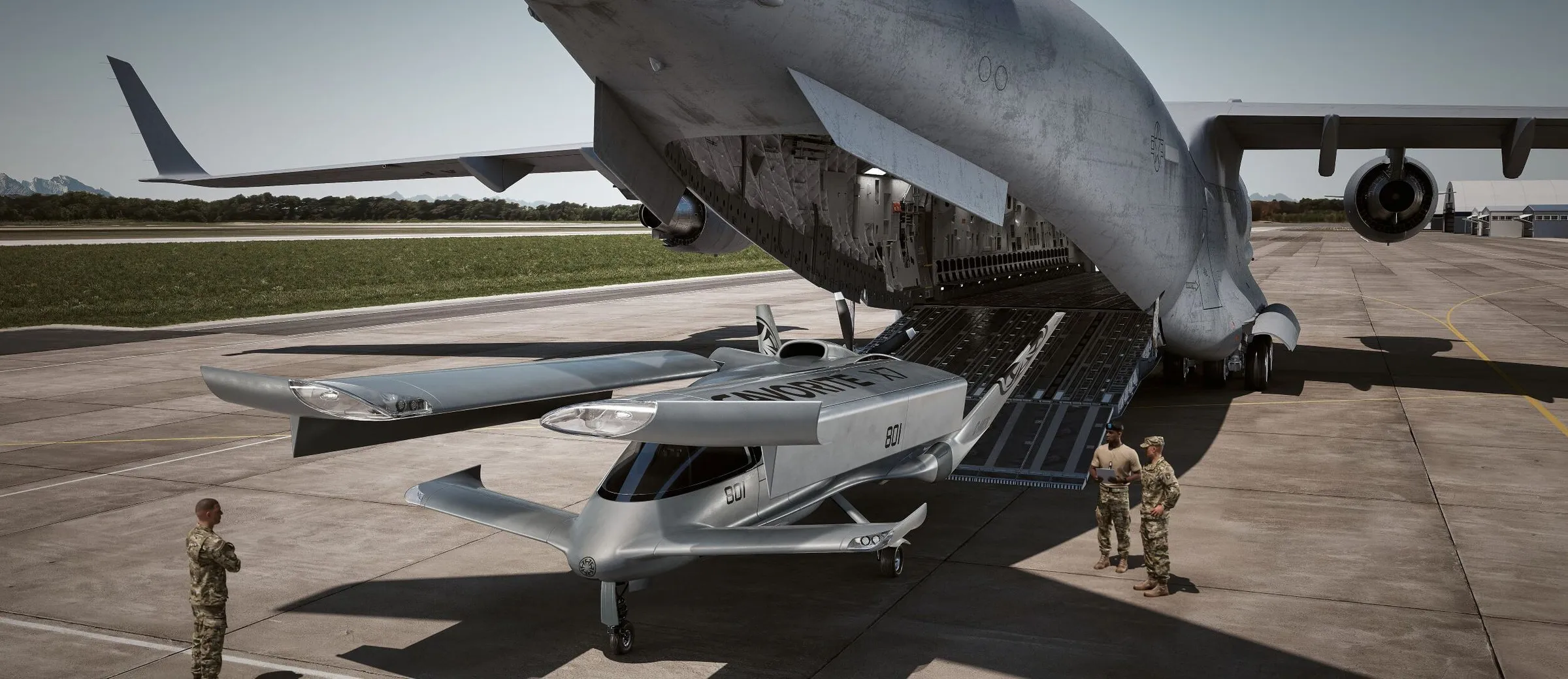
Horizon Aircraft expects the military and the defence sector to take a growing interest in eVTOL (electric Vertical Take-Off and Landing). Brandon Robinson, CEO of the Canadian company, said: “The military is focused on deepening its knowledge of the eVTOL sector and developing a better understanding of how it can be used in operations”.
According to a press release, Horizon Aircraft is convinced that its own eVTOL design, with its capacity for high speed and long range, is suited to moving troops quickly and bringing equipment to remote areas. The unmanned aircraft could also be effective in military search and rescue missions and medical evacuations. In addition, hybrid eVTOLs offer “improved military maintenance efficiency with lower cost and time per flight hour”.
The company also sees itself well placed on sustainability, an issue of growing importance: the Horizon Aircraft Cavorite X7 Hybrid eVTOL, currently under development, is expected to have less environmental impact than conventional helicopters.
Electric hover, turboprop cruise
This is to be achieved by combining eVTOL hover flight with efficient turboprop cruise. Phil Kelly, Senior Vice President Business Development since July 2024, said of the Cavorite X7: “It is an exceptional and unique aircraft that offers high-speed and long-range capabilities compared with helicopters and pure eVTOLs, and could play a key role in supporting discreet military operations with a reduced acoustic signature.”
A gross weight of around 2,500 kilograms and an estimated payload of approximately 680 kilograms are expected. Added to this are a top speed of about 400 kilometres per hour and a range of just over 800 kilometres including fuel reserves. According to the company, this makes the unmanned eVTOL system well placed “for use in medical evacuation, delivery of critical goods, disaster relief and special military missions”.
Kelly continued: “Now that our flight testing is well advanced, we want to intensify our dialogue with the military to discuss how we can support missions that have not previously been possible for them at this payload size. I see it as an ideal platform for deploying special forces teams, an aircraft capable of carrying radars and other sensors, with considerable surplus electrical power (an estimated 100 kW) that can be used briefly to recharge eVTOL batteries, and it has great CASEVAC potential”.
Hybrid propulsion instead of charging infrastructure: the eVTOL in detail
Unlike many aircraft in its category, the Cavorite X7 has a hybrid-electric propulsion system. After vertical take-off, it is to recharge its batteries in flight once it is travelling in a conventional aircraft configuration. Once it has landed vertically and the mission is over, the system is to charge its own battery array – making ground-based charging infrastructure unnecessary.
The prototype in flight testing has folding wings. This enables both air transport and operations aboard ships. Finally, the company emphasises that the Cavorite X7 will fly “98 per cent of the mission in a low-drag configuration like a conventional aircraft”. In Horizon Aircraft’s view, this mode of flight is safer.
Photo credits
© Horizon Aircraft
Continue exploring

Loitering munition Virtus from Stark: 45th Armoured Brigade “Litauen” tests it at “Freedom Shield 2026”

Drone stations for maritime surveillance: Rift begins tests off the French coast

Sea drones for the Baltic: Sweden buys surveillance from Saildrone as a service

Maritime drones: Eviden unveils SMX, an electromagnetic navigation sensor
