





Maritime surveillance with the AR5: Portuguese Air Force procures Tekever unmanned system
A budget ceiling of around 7.8 million euros, delivery in September, training in two phases: the Portuguese Air Force will rely on the Tekever AR5 for maritime surveillance. Quantity and contract value remain undisclosed.
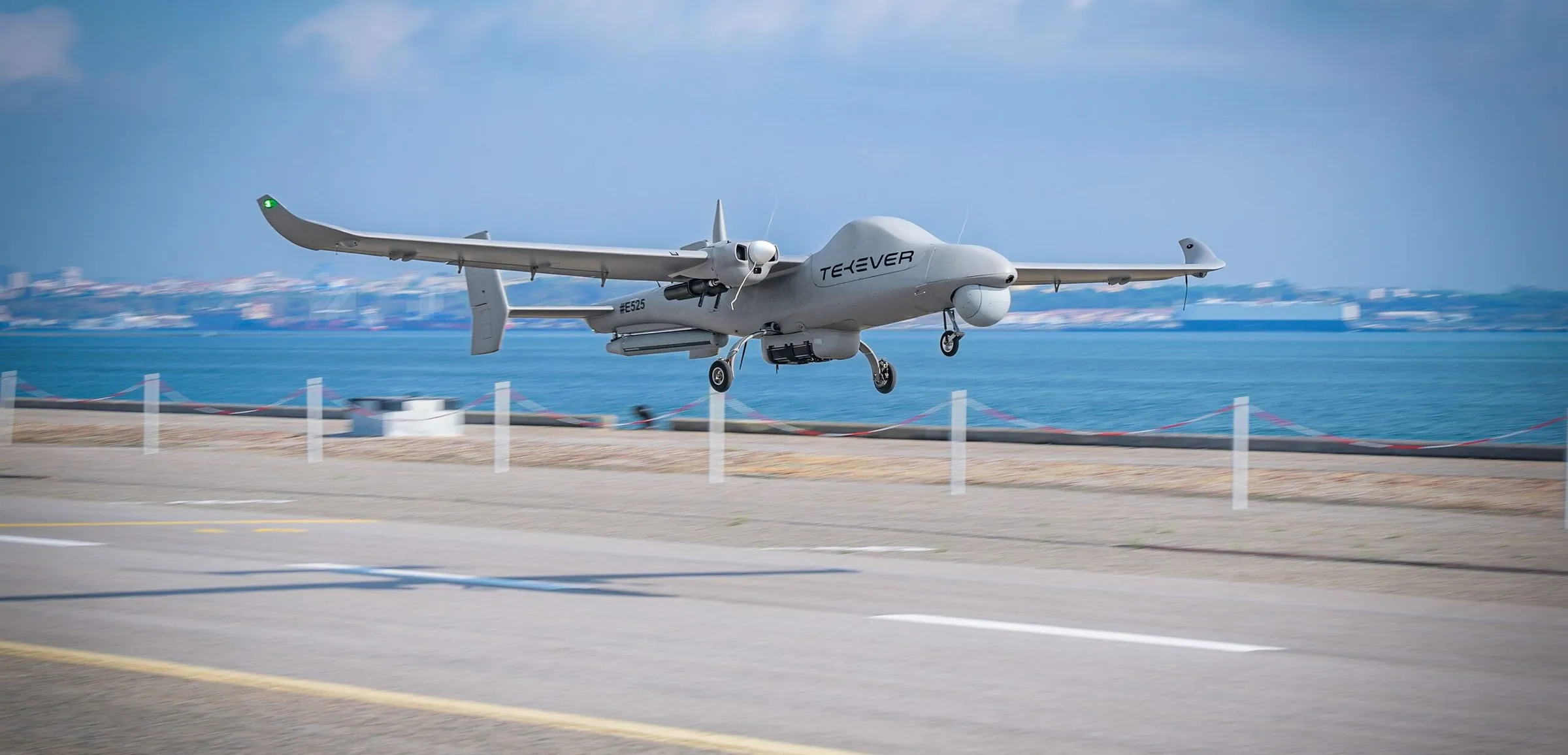
For maritime surveillance, security and defence, the Portuguese Air Force intends to operate an unmanned aircraft system (UAS) of its own: it has signed a contract with domestic manufacturer Tekever for the AR5, a medium-altitude, long-endurance platform. Delivery is planned as early as September, with initial operational capability to be reached in the same month.
What the contract covers – and what remains open
Tekever announced the agreement on 11 August. In addition to the aircraft, it includes a ground control station, the company's own Atlas mission system, operator training and the necessary knowledge transfer – so that the air force can operate the capability without the contractor's help from the outset. Neither Tekever nor the air force has disclosed how many aircraft are being procured or the value of the contract; the company referred questions on both points to the air force.

The financial framework, by contrast, is public. Order No. 13722/2025 of 19 November authorised the air force to enter into a multi-year commitment for 2025 and 2026 to acquire a Class 2 UAS – up to a maximum of around 7.8 million euros. The money comes from the Military Programming Law (Lei de Programação Militar) and is booked under the budget line for air surveillance, reconnaissance and patrols over land and sea areas. On the day of the announcement, Portuguese media assumed two aircraft; the air force has not confirmed this figure.
The choice of the AR5 comes as no surprise: the air force's annual activity report for 2025 already listed it as the selected solution. At the time, it said the contract could not be signed that year because approval by the Tribunal de Contas, Portugal's Court of Auditors, was delayed.
What is surprising, however, is how tight the schedule is after signature. According to Tekever, the first group of air force personnel will complete training by September – at the same time as the systems are delivered and initial operational capability is declared. A second training phase follows in October, intended to consolidate full operational readiness and broaden the skills base of the operating teams.
In the announcement, Lieutenant Colonel Luís Henriques, who heads the air force's AR5 working group as operations coordinator, said:
The introduction of the AR5 system represents a significant strengthening of the operational capabilities of the Portuguese Air Force. This platform meets current requirements for surveillance, security and defence and offers greater range, endurance and operational flexibility. Its integration will strengthen national capacities for monitoring the exclusive economic zone and for supporting a wide range of missions in the public interest.— Lieutenant Colonel Luís Henriques, operations coordinator of the air force's AR5 working group
Pedro Petiz, Director of Strategic Development at Tekever, put the contract into industrial perspective in the same statement:
This contract places an autonomous capability developed and produced in Portugal at the service of protecting our airspace and maritime area. Beyond the delivery of the aircraft, we will work with the Portuguese Air Force to consolidate and develop its own operational capability.— Pedro Petiz, Director of Strategic Development at Tekever
The AR5 at a glance

The AR5 is designed as a twin-engine unmanned fixed-wing aircraft for reconnaissance, surveillance and scouting missions over large areas, at medium altitude and with long endurance. Tekever markets it as Europe's first UAS-based maritime surveillance system. The system is ITAR-free, built to EASA production standards and has redundant critical flight systems as well as automatic take-off and landing. When the aircraft leaves local reception range, it switches in a controlled manner from radio line-of-sight to beyond-line-of-sight satellite data links, so that a single mission can continue without interruption. The AR5 has been in service since 2015 and has flown surveillance missions in Portugal, Spain, France, Italy and the Baltic states.
With dimensions of 7.3×4.0 metres, the maximum take-off weight is 180 kilograms, of which 50 kilograms can be payload. Depending on payload, the AR5 stays airborne for 16 to 20 hours; it climbs to a maximum of 3.6 kilometres and cruises at 100 km/h. Communication reaches around 230 kilometres via RLOS and is unlimited via SATCOM. For take-off and landing, the AR5 needs only an (unpaved) strip of around 200 to 300 metres.
The payload bay is modular. Options listed by the manufacturer include:
- a gyro-stabilised gimbal with five sensors, several electro-optical and infrared sensors and 30x optical zoom
- a maritime search radar
- AIS receivers and EPIRB antennas to identify vessels and locate distress calls
- a synthetic aperture radar
- SIGINT and ELINT packages
Tekever's LifeSaver system also enables the aircraft to drop life rafts. For a service that constantly performs search and rescue (SAR) tasks over one of the largest SAR regions in the Atlantic, this function is of direct relevance. Which sensor fit the Portuguese Air Force has chosen has not been disclosed.
Maritime surveillance: what changes for the air force
Unmanned operations are not new territory for the air force. Since 2019 it has used the UAVision OGASSA OGS 42N/VN, assigned to Esquadra 991 “Harpias”. The squadron was activated on 17 November 2021 at Ota; it is the first Portuguese squadron created specifically to operate unmanned systems and has twelve aircraft. By the end of 2025, the air force had flown more than 1,500 unmanned missions, around 640 of them in support of wildfire fighting.


Nor are the ambitions for long-range maritime surveillance new. In October 2022, an Esquadra 991 aircraft flew from Beja to Porto Santo – around 940 kilometres over open sea – taking 8 hours and 25 minutes on only half a tank of fuel. The air force saw this at the time as a step towards long-range maritime surveillance.
What sets the AR5 apart from the aircraft already in use in Portugal, however, is not its beyond-the-horizon range. The current Ogassa Horizon from UAVision is credited with 15 hours of endurance and 1,400 kilometres of range with a full intelligence, surveillance and reconnaissance (ISR) payload, plus a beyond-line-of-sight data link of up to 120 kilometres and integration with the Starlink and Iridium SBD constellations. The difference lies in the AR5's payload: 50 kilograms on the gimbal plus around five kilograms on external hardpoints.

This margin allows a maritime search radar, AIS receiver, EPIRB antennas, synthetic aperture radar and signals intelligence packages to be carried – an operationally decisive difference. While an electro-optical turret has to be pointed at something, a maritime radar searches dozens of kilometres and also works in weather that would put an optical sensor out of action. The 2022 flight proved that a Portuguese unmanned system can reach a distant target. With the AR5, the question is what the system can do once it gets there.
The planned tasks are maritime surveillance, security and defence, monitoring of the exclusive economic zone (EEZ) and coastal security. These are joined by public-interest tasks such as environmental protection and support for DECIR, the national system for fighting rural wildfires. Portugal administers one of the largest exclusive economic zones in the European Union, extending west to the Azores and south to Madeira. The air force has not yet announced where the AR5 will be based or whether it will join Esquadra 991 or a newly formed unit.
“Deep Find” upgrade
Beyond the baseline fit, Tekever also offers the AR5 in a more powerful reconnaissance configuration marketed as “Deep Find”. Nothing indicates that Portugal has procured this variant. A description is nonetheless worthwhile, as it shows the possible development path for any AR5 operator.

At the heart of this version is an IMSAR NSP-7 or NSP-5 radar. It delivers synthetic aperture and inverse SAR imagery and detects moving maritime and ground targets (GMTI); detection ranges are given as 55 kilometres in SAR mode and 24 kilometres in GMTI mode. Data is processed on board in near real time, supported by automatic detection algorithms. A Hoodtech AC14 turret adds mid-wave and short-wave infrared imaging, as well as a high-power laser designator that can support guided munitions. Phased-array ELINT payloads allow geolocation and direction finding at distances of up to 200 kilometres.
In this configuration the AR5 is no longer just a sensor but a node. A relay function over 60 kilometres extends the range and electronic warfare resilience of other unmanned systems – including the smaller AR3. Link 16 integration allows the aircraft to contribute to a broader tactical picture. The contested end of the mission spectrum is covered by a high-band SATCOM designed for environments without GPS and global navigation satellite system (GNSS) reception, a custom autopilot with electronic counter-warfare functions and an optional vision-based navigation module.

Tekever states an endurance of 16 hours for this configuration. That equates to a one-way flight of 1,500 kilometres or out-and-back flights of 750 kilometres. This version can take off from a 300-metre strip on unpaved ground.
A growing customer base abroad
Portugal joins a customer base that has grown strongly over the past year. Only at the end of July, the United Kingdom selected the AR5 under Project CORVUS to replace the British Army's Thales Watchkeeper WK450 Mk1, which is due to be retired next year. The framework contract covers up to 470 million euros over ten years; firmly committed, however, is a much smaller core – a five-year contract worth around 160 million euros. The remainder is an option for additional equipment, incremental development and up to five further years of support. Six aircraft have been ordered initially, rising to up to 24 by 2029; deliveries are scheduled to begin before the end of this year.
In November 2025, the European Maritime Safety Agency (EMSA) awarded Tekever a framework contract worth 30 million euros for fixed-wing UAS services. It initially runs for two years and can be extended to four. It provides for two systems with two aircraft each, so that flights can take place in several regions in parallel. In the EMSA configuration, the AR5's endurance is given as twelve hours.

At home, the air force contract follows an order worth 1.5 million euros awarded in June, under which Tekever is supplying the smaller AR3 EVO to the Autoridade Marítima Nacional for the Polícia Marítima. UAVision and NTG also took part in that tender; according to the authority, further procurements of unmanned systems are to follow in the course of 2026. Tekever has also opened a subsidiary in Estonia, where a public tender is currently under way.
What the AR5 contract means for the air force is measured less by its size than by what it establishes. Two aircraft – if that figure is confirmed – cannot permanently cover an area the size of Portugal's maritime zone. What it does provide, however, is an operational foundation in a payload class the armed forces have not operated before: in national hands, backed by a national supplier and expandable through a still-open budget line of the Military Programming Law.
Photo credits
© Tekever · © Santiago Anacleto
Continue exploring

Loitering munition Virtus from Stark: 45th Armoured Brigade “Litauen” tests it at “Freedom Shield 2026”

Drone stations for maritime surveillance: Rift begins tests off the French coast

Sea drones for the Baltic: Sweden buys surveillance from Saildrone as a service

Maritime drones: Eviden unveils SMX, an electromagnetic navigation sensor
