





Unmanned ground vehicles with a driver's seat: Eiselin Landsystems shows Sand-X DOV at the KSK symposium
Drive it crewed, control it remotely from a backpack or let it run autonomously: at the KSK symposium, Eiselin Landsystems uses the Sand-X DOV to show how unmanned ground vehicles for the “last 100 miles” can be designed – operable from minus 45 to plus 50 degrees Celsius.
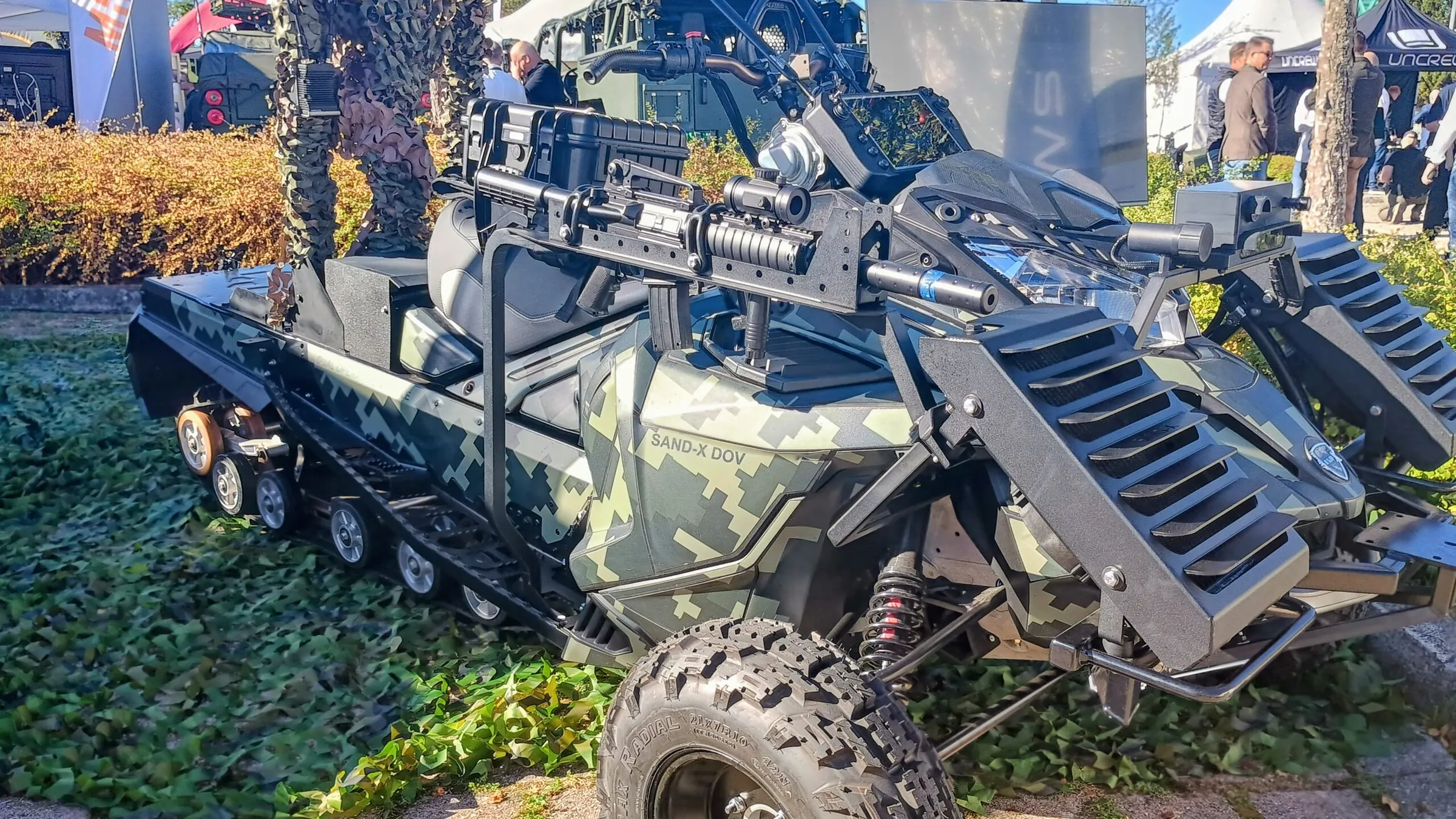
Unmanned ground vehicles that can also be driven with a driver when required – Eiselin Landsystems showed this concept with the Sand-X Dual Operating Vehicle (DOV) at the symposium of the KSK (Kommando Spezialkräfte, German special forces). The vehicle is intended for the “last 100 miles”, i.e. those mission segments where roads, infrastructure and conventional vehicle logistics are no longer sufficient.
The Sand-X concept goes back around 25 years; it was developed for different terrain and climate zones. The company says the vehicle operates between minus 45 and plus 50 degrees Celsius – in Arctic conditions as well as hot, dry theatres. The platform can be operated crewed, remotely controlled or autonomously; it is designed for reconnaissance, casualty transport, logistics tasks and fire support.
One platform, several roles
Versatility is the basic principle: depending on the mission, the vehicle can be equipped for reconnaissance purposes, as a MEDEVAC vehicle, for materiel transport or for fire support. Rather than keeping a separate platform for each task, a single vehicle is adapted to the mission profile.
Propulsion comes from a Finnish-built four-stroke three-cylinder engine; according to Eiselin Landsystems, the system is produced in Germany. Compact design, off-road capability and mission-specific equipment together are meant to make the vehicle attractive above all to rapid-reaction forces and for operations far from fixed infrastructure.
Unmanned ground vehicles with a control station in a backpack
Central to the Sand-X DOV is the rapid switch between crewed and uncrewed operation. All components needed for remote operation sit in a control station carried in a backpack.

Whether it is driven by a driver or unmanned therefore need not be decided before a mission begins; the crew can change the operating mode as the situation requires. Beyond remote control, autonomous operation is also possible, according to the company.
Various options are available for communications – a mesh network, Starlink and other radio solutions were mentioned. The vehicle is thus intended to remain controllable and integrated into mission command even when conventional communication channels fail or are only partly usable.

Battlefield radar and sensors on board
A special version of the Sand-X DOV was shown at the KSK symposium. On board were a Ground Observation GO12 battlefield radar from Thales, thermal imaging and infrared sensors as well as cameras.
Equipped in this way, the platform serves not only to transport materiel or personnel but also as a mobile reconnaissance platform. The battlefield radar as well as optical and thermal sensors are intended to give the crew – or the operator at the remote control – an improved situational picture.
Photo credits
© Militär Aktuell/Bendl
Continue exploring

Loitering munition Virtus from Stark: 45th Armoured Brigade “Litauen” tests it at “Freedom Shield 2026”

Drone stations for maritime surveillance: Rift begins tests off the French coast

Sea drones for the Baltic: Sweden buys surveillance from Saildrone as a service

Maritime drones: Eviden unveils SMX, an electromagnetic navigation sensor
